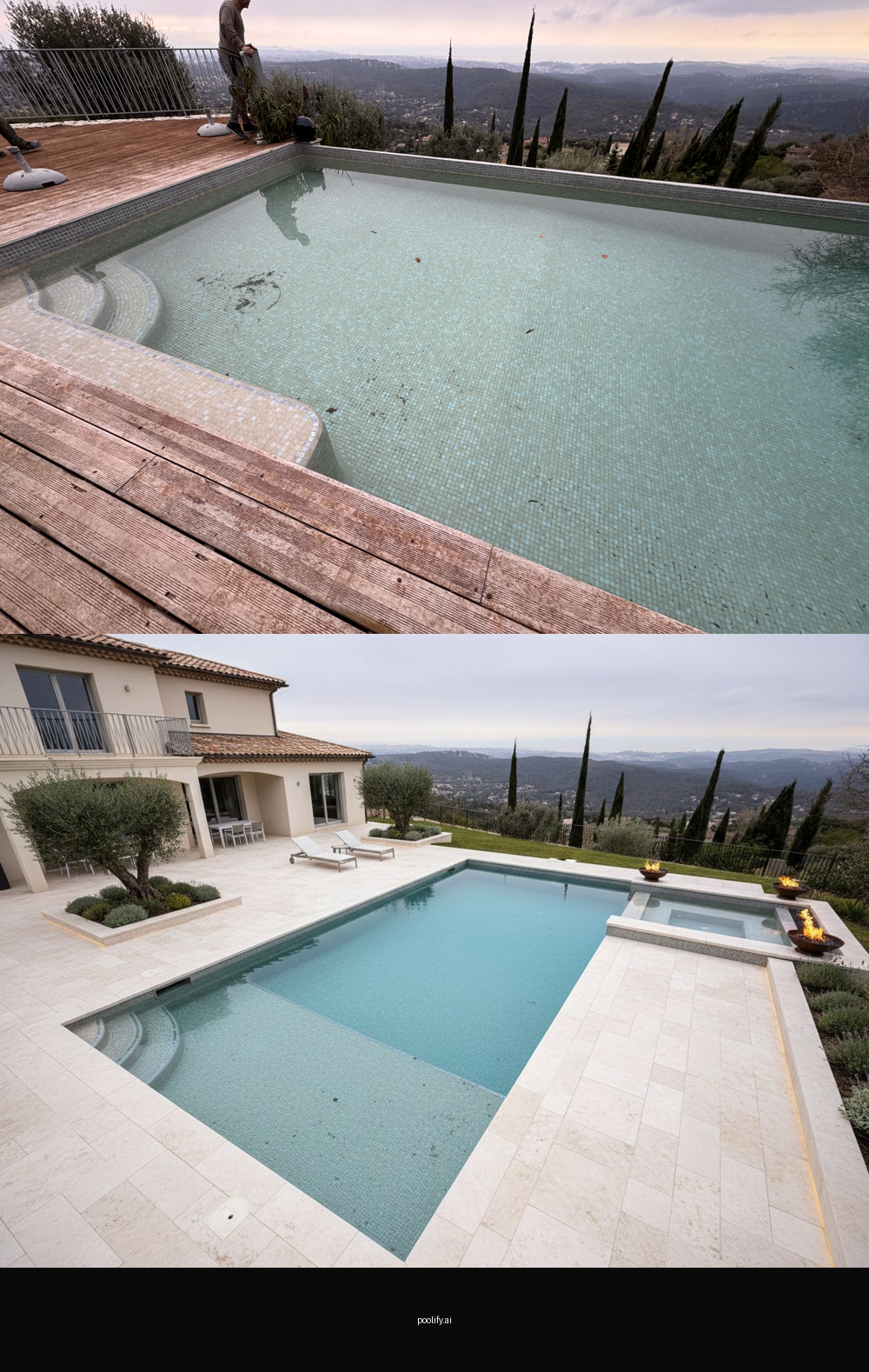
Modern pool design in a four-season climate has an extra requirement: it has to look composed when the pool is closed. Any design that only resolves in midsummer will spend most of the year looking unresolved.
This guide covers how to keep a clean, modern design coherent across a full year of weather and use.
Modern Design Has to Survive the Off Season
A minimal design has nowhere to hide. Covers, stored furniture and exposed equipment read as clutter against clean geometry in a way they do not against a busier landscape.
Plan the closed state deliberately
- Where the cover sits and how it looks
- Where furniture is stored
- How equipment is screened year round
- Whether decking stands alone visually
- What the view from indoors becomes
Sketching the closed state alongside the open one is a small step that changes several design decisions.
Choose Materials That Handle Freeze and Thaw
Repeated freezing and thawing is demanding on surfaces, joints and edges. Material selection in a cold climate is a durability decision as much as an aesthetic one, and it is worth discussing explicitly with your builder.
Raise with your builder
- Suitability of decking materials locally
- Joint detailing and movement allowance
- Coping performance in freeze conditions
- Drainage away from vulnerable edges
- Expected maintenance for each surface
Local builders have direct experience of what performs in your conditions, and that experience is more reliable than any general guidance.
Simple Geometry Ages Better
Complex shapes accumulate problems in a demanding climate: more edges, more joints, more transitions and more places for water to sit. Simple geometry is not only a modern aesthetic, it is also fewer failure points.
Advantages of restraint
- Fewer joints and transitions
- Simpler covering and closing
- Easier cleaning and maintenance
- More predictable drainage
- A cleaner look when closed
This is one of the few cases where the stylistic preference and the practical choice point in the same direction.
Plan the Cover Into the Design
Covers are frequently chosen last and then become the most visible object in the yard for months. Deciding the cover type during design allows its housing, edges and colour to be part of the composition.
Decide during design
- Cover type and how it is operated
- Where housing or storage sits
- How edges and tracks are detailed
- Colour relative to decking
- Access required to open and close
A cover that was designed for looks deliberate. One that was added looks like an accessory.
Extend the Season Deliberately
Season length is affected by design decisions such as wind exposure, shelter, and heating approach. These are worth deciding together rather than treating heating as a later purchase.
Design factors that affect use
- Shelter from prevailing wind
- Sun exposure in shoulder months
- Heating approach and its running demands
- Whether a cover retains heat
- Comfortable seating outside peak summer
Discuss the practical implications with a local professional, since what is effective depends heavily on site and climate.
Design the View From Inside the House
For much of the year, the pool is something you look at through a window. That view deserves to be composed as carefully as the view from the deck.
Check from the rooms you use
- What is framed by each window
- Whether equipment is visible
- How lighting reads after dark
- Whether the geometry aligns with the building
- What the winter view contains
Standing inside and looking out, before anything is built, is one of the more useful things you can do at design stage.
See Your Dream Pool in Your Actual Backyard
Upload a photo and get an AI-designed pool visualization in 10 seconds. 3 free designs, no login required.
Try Poolify Free →Design the closed state, keep geometry simple, choose the cover during design rather than after, and confirm material durability with a builder who works in your conditions.
