Understanding Infinity Pool Cost in 2026
The infinity pool cost has become a critical consideration for homeowners seeking to add luxury and value to their properties in 2026. As one of the most visually stunning pool designs available, infinity pools create a seamless edge where water appears to flow endlessly into the horizon. However, this architectural marvel comes with a substantial price tag that varies significantly based on design complexity, location, materials, and site conditions.
The average infinity pool cost in 2026 ranges from $80,000 to $300,000 or more, with most homeowners investing between $100,000 and $200,000 for a standard installation. This premium pricing reflects the specialized engineering, additional equipment, and expert craftsmanship required to create the signature vanishing edge effect. Understanding these cost factors helps you plan your budget effectively and make informed decisions about your pool investment.
Breaking Down the Infinity Pool Cost Components
The total infinity pool cost comprises several distinct components that contribute to the final investment. Each element plays a crucial role in both the functionality and aesthetic appeal of your pool, and understanding these individual costs helps you prioritize your budget allocation.
Excavation and Site Preparation
Site preparation typically accounts for 10-15% of the total infinity pool cost. Excavation expenses range from $5,000 to $20,000 depending on soil conditions, accessibility, and terrain challenges. Properties with sloped terrain ideal for infinity pools may require less grading work, while flat lots need additional excavation to create the necessary elevation difference for the vanishing edge effect.
Rocky soil, high water tables, or limited equipment access can significantly increase excavation costs. Some projects require specialized machinery or additional labor hours, adding $3,000 to $10,000 to the baseline excavation budget. According to the U.S. Census Bureau’s construction data, site preparation costs have increased approximately 8% year-over-year due to equipment and labor market conditions.
Pool Shell Construction
The pool shell represents the largest single expense in your infinity pool cost calculation. Concrete pools, specifically gunite or shotcrete construction, dominate the infinity pool market due to their structural integrity and customization capabilities. Shell construction typically costs $50,000 to $150,000, depending on size, shape complexity, and depth variations.
Standard infinity pools measure 12×24 feet to 20×40 feet, with depths ranging from 4 to 8 feet. Larger dimensions, custom curves, integrated spa features, or beach entries increase material requirements and labor hours. The vanishing edge itself requires additional structural support, reinforced walls, and precise engineering to ensure proper water flow and containment.
Catch Basin and Recirculation System
The catch basin distinguishes infinity pools from traditional designs and significantly impacts the overall infinity pool cost. This secondary basin collects water flowing over the vanishing edge and houses the recirculation equipment. Construction costs for catch basins range from $15,000 to $40,000, depending on size, depth, and accessibility requirements.
The recirculation system requires powerful pumps capable of moving large water volumes continuously. Commercial-grade pumps, additional plumbing, and specialized filtration systems add $8,000 to $25,000 to your infinity pool cost. These systems must maintain consistent water levels while managing the continuous overflow characteristic of infinity edge designs.
Material Selection Impact on Infinity Pool Cost
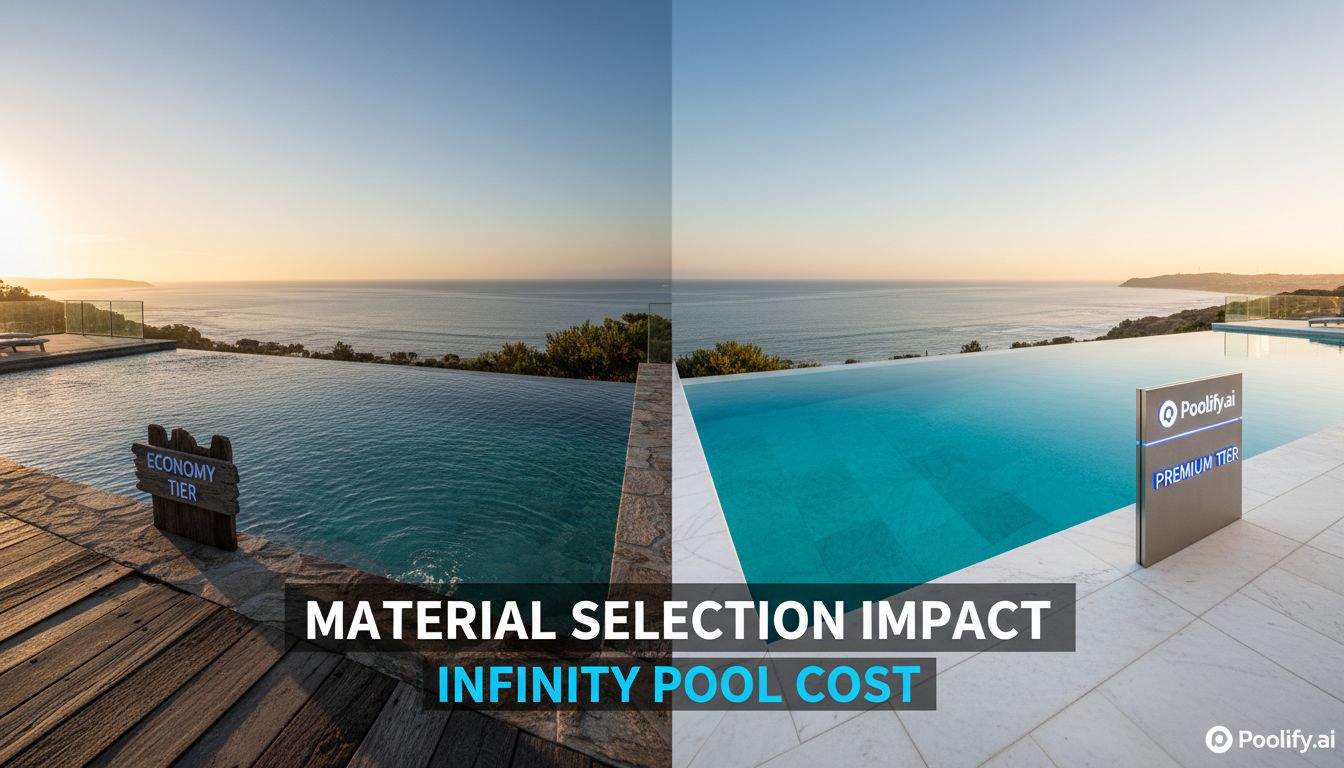
Material choices dramatically influence both the initial infinity pool cost and long-term maintenance expenses. Premium materials increase upfront investment but often provide superior durability, aesthetics, and reduced maintenance requirements over the pool’s lifespan.
Interior Finish Options
Interior finishes range from basic plaster to premium glass tiles, with costs varying from $5,000 to $50,000. Standard white plaster represents the most economical option at $5 to $10 per square foot, while aggregate finishes like pebble or quartz cost $10 to $20 per square foot. Glass tile installations, popular for their reflective properties and color vibrancy, command premium prices of $25 to $50 per square foot.
The vanishing edge requires meticulous finish work to create the seamless visual effect. Many homeowners invest in premium materials for the infinity edge and waterline while using standard finishes for less visible areas, balancing aesthetics with budget constraints. This strategic approach can reduce the infinity pool cost by $8,000 to $15,000 without compromising the signature visual impact.
Coping and Decking Materials
Coping and decking materials frame your infinity pool and contribute significantly to the overall aesthetic. Budget-conscious options like concrete pavers cost $15 to $30 per square foot installed, while natural stone selections like travertine or bluestone range from $30 to $60 per square foot. Exotic materials such as imported marble or granite can exceed $80 per square foot.
The infinity edge requires specialized coping designed to create the precise water flow pattern. Custom-cut stone, cantilevered concrete, or frameless glass edges increase material and installation costs by 20-40% compared to standard pool coping. For a typical 800-square-foot deck area, material choices can swing the infinity pool cost by $12,000 to $40,000.
Design Complexity and Customization Costs
Design complexity directly correlates with infinity pool cost escalation. While rectangular pools with single vanishing edges represent the most economical configuration, many homeowners opt for enhanced features that elevate both aesthetics and functionality.
Multiple Vanishing Edges
Pools featuring two or three vanishing edges create dramatic visual effects but require additional catch basins, enhanced structural support, and more complex hydraulic systems. Each additional vanishing edge adds approximately $20,000 to $50,000 to the base infinity pool cost. The engineering complexity increases exponentially with multiple edges, requiring precise calculations to ensure balanced water flow and structural integrity.
Integrated Water Features
Water features like fountains, waterfalls, fire bowls, or spillways enhance the infinity pool experience but increase total investment. Simple laminar jets cost $500 to $2,000 each, while elaborate rock waterfalls range from $5,000 to $30,000. Fire and water features combining flames with water effects command premium prices of $3,000 to $15,000 per feature.
These additions require dedicated plumbing lines, electrical systems, and often gas connections for fire features. Installation complexity and permit requirements can add 15-25% to the base feature cost. Learn more about enhancing your pool with water features to understand design possibilities and budget implications.
Lighting Systems
Sophisticated lighting transforms infinity pools into nighttime focal points. LED lighting systems cost $2,000 to $10,000 depending on the number of fixtures, color-changing capabilities, and automation integration. Fiber optic systems, which create starlight effects or illuminate the vanishing edge, range from $5,000 to $20,000 installed.
Smart lighting systems integrated with home automation platforms add $1,500 to $5,000 to the infinity pool cost but provide convenient control and programmable lighting scenes. Underwater lighting requires specialized fixtures rated for submersion, while perimeter lighting enhances safety and ambiance around the pool deck area.
Geographic Location and Regional Infinity Pool Cost Variations
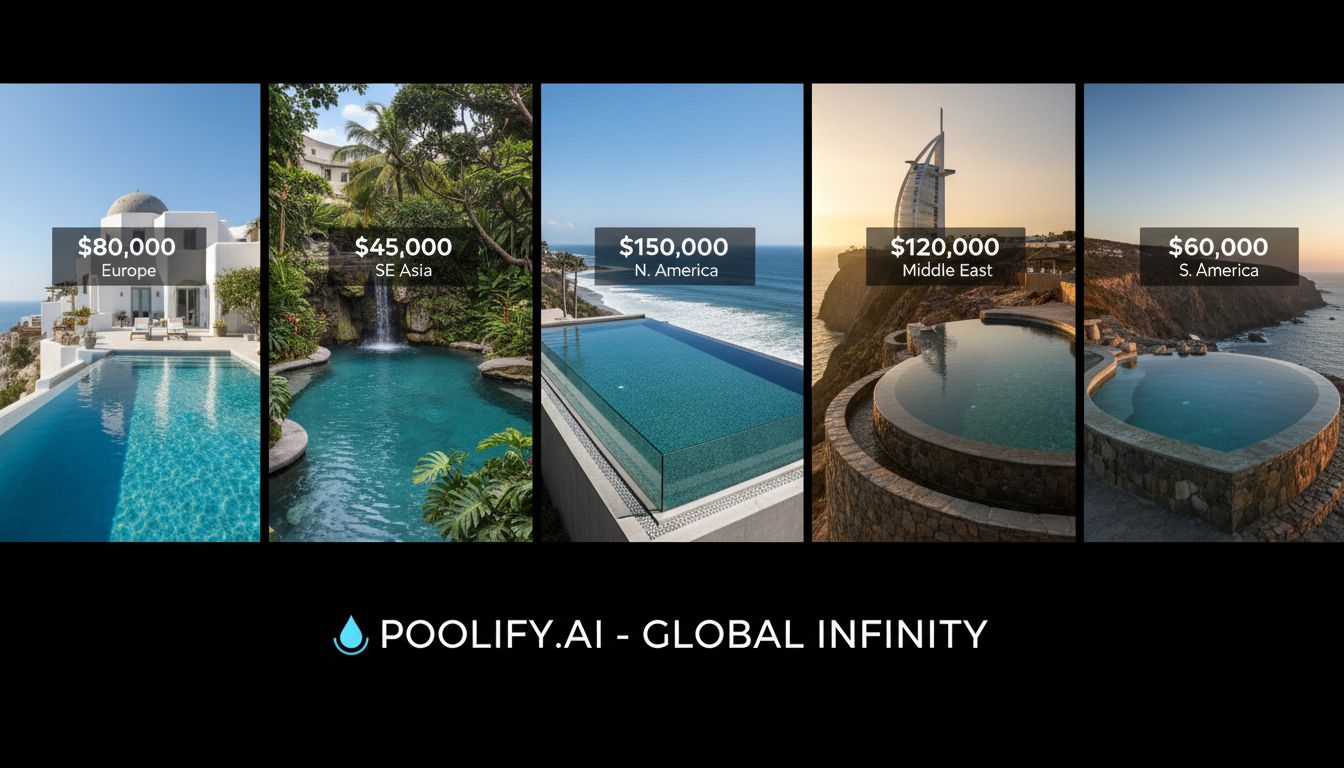
Geographic location significantly influences infinity pool cost through labor rates, material availability, permit fees, and climate-specific requirements. Regional variations can create 30-50% price differences for identical pool specifications across different markets.
Labor Market Conditions
Labor costs represent 40-50% of total infinity pool cost, and regional wage differences create substantial price variations. Metropolitan areas with high living costs like San Francisco, New York, or Miami typically charge $75 to $150 per hour for skilled pool contractors, while smaller markets may charge $50 to $90 per hour. A project requiring 800 labor hours could vary by $20,000 to $50,000 based solely on regional labor rates.
Contractor availability also impacts pricing and timelines. Markets with high demand and limited qualified infinity pool specialists command premium rates. Scheduling during peak construction seasons (spring and summer) may increase costs by 10-20% compared to off-season bookings.
Climate Considerations
Climate conditions influence both construction costs and ongoing operational expenses. Cold-climate installations require freeze-protection measures, deeper plumbing lines, and winterization capabilities, adding $5,000 to $15,000 to the infinity pool cost. Heating systems become essential in cooler regions, with installation costs ranging from $3,000 for basic heaters to $15,000 for high-efficiency heat pumps.
Conversely, hot climates may require enhanced circulation systems, larger filtration equipment, and additional water features to maintain comfortable temperatures. Desert environments face higher evaporation rates, increasing water replacement costs and potentially requiring automatic water leveling systems costing $1,500 to $4,000.
Permit and Regulatory Requirements
Permit fees and regulatory compliance costs vary dramatically by jurisdiction. Basic pool permits range from $500 to $5,000, while comprehensive approvals including structural, electrical, plumbing, and environmental permits can exceed $10,000 in highly regulated markets. Coastal properties may require additional environmental impact assessments costing $2,000 to $8,000.
Some municipalities mandate specific safety features like pool fencing, alarms, or cover systems, adding $2,000 to $10,000 to the infinity pool cost. Homeowners association (HOA) approvals may require architectural review fees, design modifications, or landscape screening, potentially adding $1,000 to $5,000 to project expenses.
Hidden Costs and Budget Considerations
Beyond the obvious construction expenses, several hidden costs impact the total infinity pool cost. Anticipating these additional expenses prevents budget overruns and ensures adequate financial preparation for your pool project.
Utility Infrastructure Upgrades
Infinity pools require substantial electrical capacity for pumps, heaters, lighting, and automation systems. Electrical panel upgrades cost $1,500 to $4,000, while dedicated circuits and outdoor outlets add $500 to $2,000. Gas line extensions for heaters or fire features range from $1,000 to $5,000 depending on distance from the main supply.
Water supply considerations include adequate flow rates for initial filling and ongoing maintenance. Some properties require water meter upgrades or pressure booster systems costing $1,000 to $3,000. Well-water systems may need enhanced capacity or treatment systems adding $3,000 to $10,000 to the infinity pool cost.
Landscaping and Hardscaping
Pool construction disrupts existing landscaping, requiring restoration or redesign. Landscape replacement costs $5,000 to $25,000 depending on property size and plant selections. Many homeowners invest in enhanced landscaping to complement their infinity pool, with comprehensive designs ranging from $15,000 to $75,000 for plants, irrigation, lighting, and hardscape elements.
Retaining walls may be necessary to manage elevation changes or create the ideal backdrop for the vanishing edge effect. These structures cost $50 to $150 per linear foot depending on height, materials, and engineering requirements. For properties requiring significant grading or terracing, retaining wall costs can add $10,000 to $50,000 to the project budget.
Furniture and Accessories
Completing your infinity pool environment requires furniture, shade structures, and accessories. Quality outdoor furniture sets cost $3,000 to $15,000, while pergolas or cabanas range from $5,000 to $30,000. Automated pool covers, which enhance safety and reduce heating costs, add $8,000 to $20,000 to the infinity pool cost but provide long-term operational benefits.
Pool maintenance equipment including robotic cleaners ($800-$2,500), testing kits ($100-$300), and initial chemical supplies ($300-$800) represent additional upfront investments. Many homeowners also install outdoor kitchens, fire pits, or entertainment systems, which can add $10,000 to $100,000+ depending on scope and quality.
Financing Your Infinity Pool Investment
Given the substantial infinity pool cost, most homeowners explore financing options to manage the investment. Several financing strategies offer different advantages depending on your financial situation, home equity, and tax considerations.
Home Equity Financing
Home equity loans and lines of credit (HELOCs) represent popular financing methods for infinity pools. These options typically offer lower interest rates than personal loans because they’re secured by your property. Home equity loans provide lump-sum funding with fixed interest rates ranging from 6% to 10% in 2026, while HELOCs offer flexible draw periods with variable rates.
For a $150,000 infinity pool cost financed through a 15-year home equity loan at 7.5% interest, monthly payments would approximate $1,390, with total interest costs around $100,000 over the loan term. The interest may be tax-deductible if the pool qualifies as a home improvement that increases property value, though tax laws vary and professional consultation is recommended.
Pool-Specific Financing Programs
Many pool contractors partner with specialized lenders offering pool-specific financing programs. These options provide streamlined approval processes and terms ranging from 5 to 20 years. Interest rates typically fall between 7% and 12% depending on creditworthiness, with some programs offering promotional periods with reduced or deferred interest.
Pool financing programs may include flexible payment options, seasonal payment structures, or interest-only periods during construction. However, these loans often carry higher rates than home equity options and may include origination fees of 1-3% of the loan amount, adding $1,000 to $5,000 to the effective infinity pool cost.
Cash Payment Advantages
Cash payments eliminate interest costs and may provide negotiating leverage with contractors. Many builders offer 3-5% discounts for cash payments, potentially saving $3,000 to $15,000 on a typical infinity pool cost. Cash transactions also accelerate project timelines by eliminating financing approval delays and simplify the overall process.
However, cash payments should preserve adequate emergency reserves and not compromise other financial goals. Financial advisors generally recommend maintaining 6-12 months of living expenses in liquid savings even after major home improvements. Check out our guide on pool financing strategies for comprehensive information on funding your pool project.
Return on Investment and Property Value Impact
Understanding the infinity pool cost requires evaluating both the immediate investment and long-term value proposition. Infinity pools impact property values, lifestyle enjoyment, and ongoing expenses in ways that differ from standard pool installations.
Property Value Enhancement
Infinity pools typically increase property values by 5-15% in appropriate markets, though actual appreciation varies based on location, home value, and neighborhood characteristics. In luxury markets where pools are expected amenities, a well-designed infinity pool may recover 50-75% of its installation cost in added property value. However, in markets where pools are less common or climate limits seasonal use, value recovery may drop to 25-40%.
The most significant value returns occur in properties with exceptional views where the infinity edge enhances the natural vista. Oceanfront, lakefront, or mountain properties with properly positioned infinity pools command premium prices because the pool becomes integral to the property’s appeal. According to real estate market analyses, luxury properties with infinity pools sell 20-30% faster than comparable homes with standard pools or no pools.
Lifestyle and Enjoyment Value
Beyond financial returns, infinity pools provide intangible lifestyle benefits that justify the investment for many homeowners. The visual drama, entertainment possibilities, and daily enjoyment create value that transcends simple cost-benefit analysis. Families report increased time spent at home, enhanced entertainment capabilities, and improved quality of life with infinity pool installations.
Health and wellness benefits include convenient exercise opportunities, stress reduction, and family bonding experiences. For homeowners planning to remain in their properties long-term, these lifestyle enhancements often outweigh pure financial considerations when evaluating the infinity pool cost investment.
Ongoing Maintenance and Operational Costs
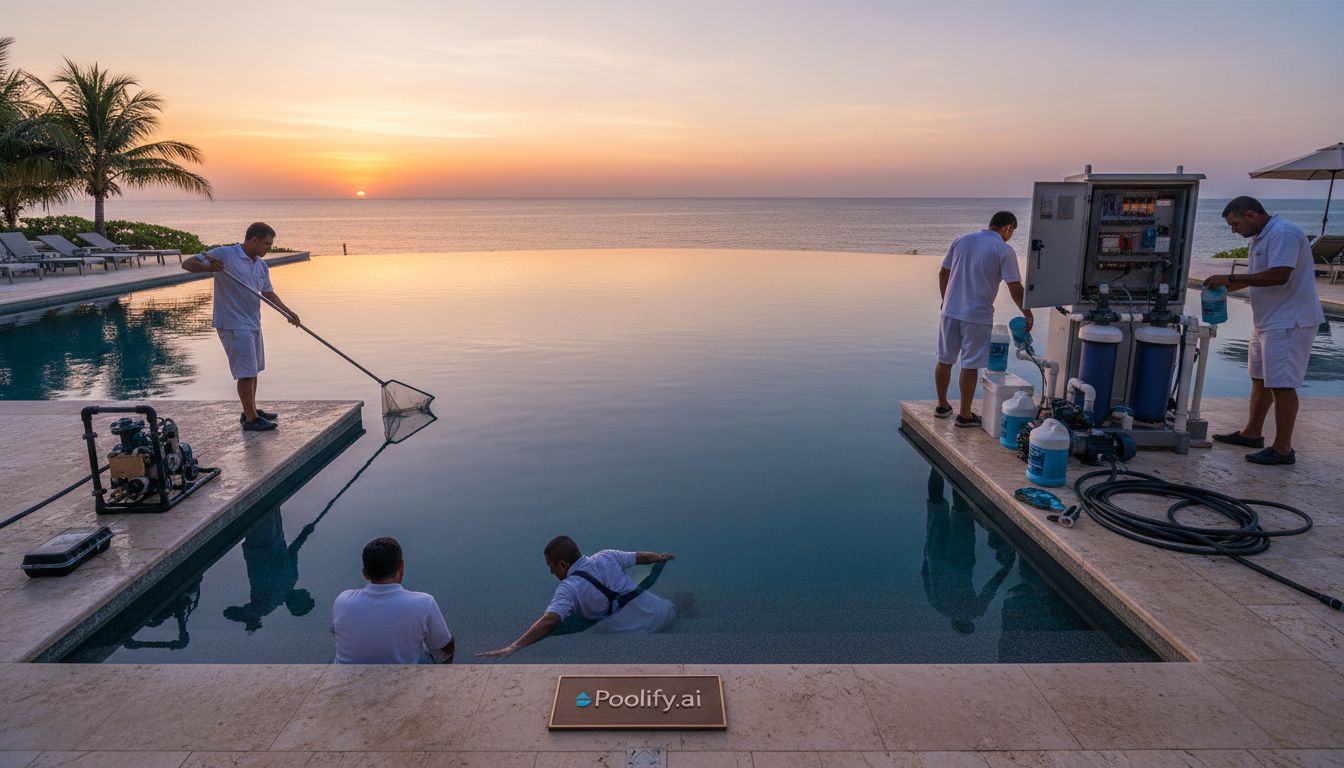
The initial infinity pool cost represents only the beginning of your financial commitment. Understanding ongoing operational expenses helps you budget accurately and avoid financial surprises after installation.
Monthly Operating Expenses
Infinity pools typically cost $150 to $400 monthly to operate, with variations based on climate, usage patterns, and energy rates. Electricity for pumps, heaters, and lighting represents the largest ongoing expense, averaging $80 to $200 monthly. The continuous recirculation required for the vanishing edge effect increases energy consumption 20-30% compared to standard pools.
Chemical costs range from $30 to $80 monthly, while water replacement due to evaporation and splashing adds $20 to $60 monthly in most climates. Heated pools in cooler climates can incur heating costs of $100 to $400 monthly during swimming season, significantly impacting annual operational budgets.
Maintenance and Repairs
Professional maintenance services cost $100 to $300 monthly and include water testing, chemical balancing, equipment inspection, and cleaning. DIY maintenance reduces costs to $50 to $100 monthly for chemicals and supplies but requires time commitment and technical knowledge. For comprehensive information on maintenance requirements, explore our complete pool maintenance guide.
Equipment repairs and replacements create periodic expenses averaging $500 to $2,000 annually. Pump replacements cost $800 to $2,500 every 8-12 years, while heater replacements range from $2,000 to $5,000 every 10-15 years. The specialized equipment required for infinity pools often commands premium prices and may require manufacturer-certified technicians for repairs.
Insurance Considerations
Infinity pools impact homeowners insurance premiums, typically increasing annual costs by $200 to $800. Liability coverage becomes especially important given the attractive nuisance doctrine and potential safety concerns. Some insurers require specific safety features like fencing, alarms, or covers to maintain coverage, potentially adding to the effective infinity pool cost.
Umbrella liability policies provide additional protection beyond standard homeowners coverage and cost $200 to $500 annually for $1-2 million in coverage. These policies protect against catastrophic liability claims related to pool accidents or injuries, offering peace of mind for pool owners.
Frequently Asked Questions About Infinity Pool Cost
How much does an infinity pool cost compared to a regular pool?
Infinity pools typically cost 30-50% more than standard pools of comparable size. The premium reflects additional engineering, the catch basin construction, specialized recirculation equipment, and expert installation required for the vanishing edge effect. A standard pool costing $60,000 would likely cost $80,000-$90,000 as an infinity design with similar dimensions and features.
What is the most expensive part of infinity pool construction?
The pool shell and catch basin system represent the most expensive components, typically accounting for 50-60% of total infinity pool cost. These elements require extensive excavation, structural engineering, reinforced concrete work, and precise construction to achieve the signature vanishing edge effect while ensuring long-term structural integrity and proper water management.
Can I build an infinity pool on a flat lot?
Yes, infinity pools can be built on flat lots, though construction costs increase by $15,000-$40,000 compared to sloped properties. Flat lots require additional excavation to create elevation differences, raised deck areas, or elevated pool structures. The catch basin must be positioned lower than the main pool, necessitating deeper excavation or raised pool construction to achieve the necessary elevation differential.
How long does infinity pool construction take?
Infinity pool construction typically requires 12-20 weeks from excavation to completion, approximately 2-4 weeks longer than standard pool installations. The timeline depends on design complexity, site conditions, weather, permit approval processes, and contractor scheduling. Custom features, challenging terrain, or extensive landscaping can extend construction to 6-9 months for comprehensive projects.
Do infinity pools require more maintenance than regular pools?
Infinity pools require slightly more maintenance due to increased water circulation, larger surface areas exposed to debris, and the catch basin system. Maintenance time increases approximately 20-30% compared to standard pools, though the basic tasks remain similar. The catch basin requires periodic cleaning, and the continuous water movement can accelerate chemical consumption, increasing ongoing operational costs by $30-$80 monthly.
Key Takeaways
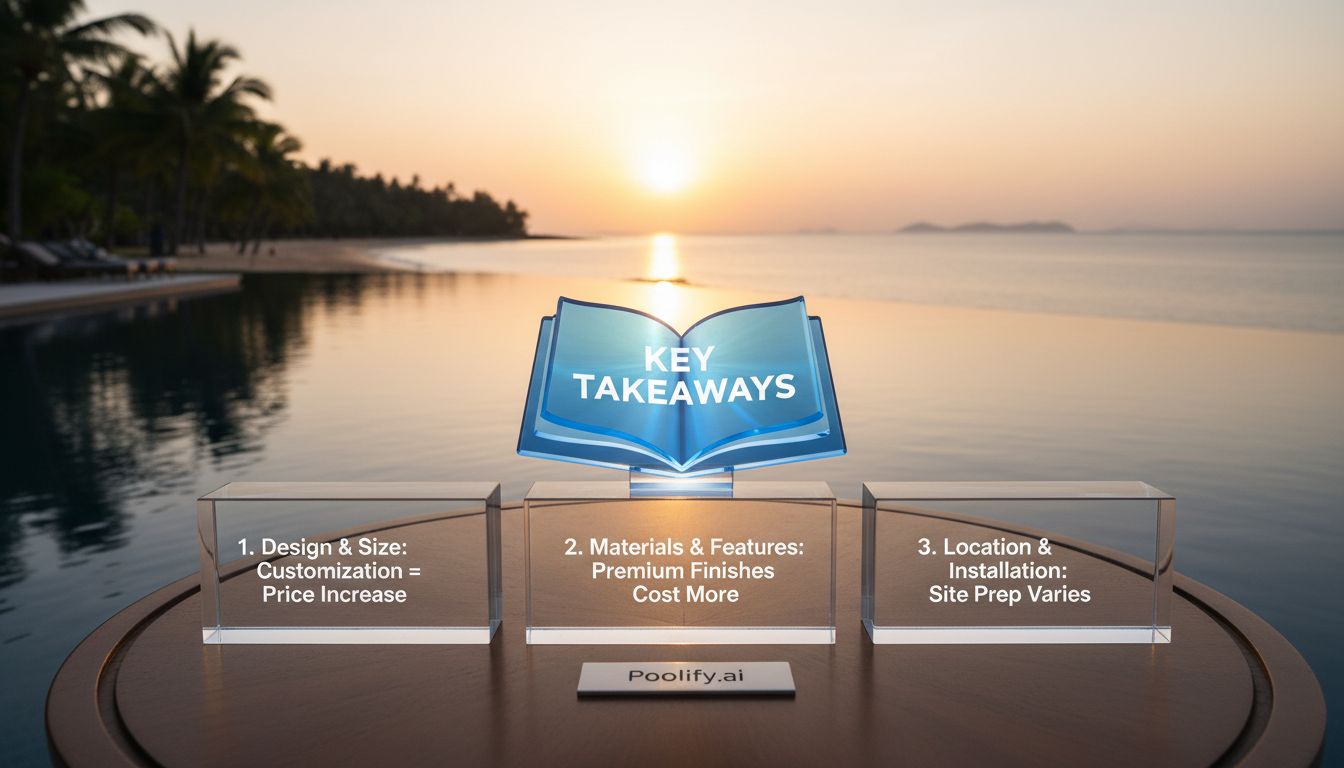
- Comprehensive Budget Planning: The infinity pool cost ranges from $80,000 to $300,000+ in 2026, with most installations falling between $100,000 and $200,000. Budget for 10-15% contingency to cover unexpected site conditions, design changes, or hidden expenses discovered during construction.
- Design Complexity Drives Costs: Multiple vanishing edges, custom shapes, integrated water features, and premium materials significantly increase the infinity pool cost. Strategic material selection and design simplification can reduce expenses by $20,000-$50,000 without compromising the signature infinity edge aesthetic.
- Location Matters Significantly: Geographic location impacts infinity pool cost through labor rates, material availability, climate requirements, and permit fees. Regional variations create 30-50% price differences for identical specifications, making local market research essential for accurate budgeting.
- Hidden Costs Add Up: Beyond construction expenses, budget for utility upgrades ($2,500-$9,000), landscaping restoration ($5,000-$25,000), furniture and accessories ($3,000-$15,000), and permit fees ($500-$10,000). These additional costs can add 15-30% to the base infinity pool cost.
- Ongoing Expenses Require Planning: Monthly operational costs of $150-$400 plus annual maintenance expenses of $2,000-$5,000 represent significant long-term financial commitments. Factor these ongoing costs into your decision-making process to ensure the infinity pool investment aligns with your long-term budget capacity.
See Your Dream Pool in Your Actual Backyard
Upload a photo and get an AI-designed pool visualization in 10 seconds. 3 free designs, no login required.
Try Poolify Free →Conclusion
The infinity pool cost represents a substantial investment that requires careful planning, comprehensive budgeting, and realistic expectations about both upfront and ongoing expenses. In 2026, homeowners can expect to invest $80,000 to $300,000 or more for these architectural masterpieces, with final costs determined by size, design complexity, materials, location, and site-specific factors.
Understanding the complete cost picture—from initial excavation through ongoing maintenance—empowers you to make informed decisions aligned with your financial capacity and lifestyle goals. While infinity pools command premium pricing compared to standard designs, they deliver unmatched visual drama, enhanced property values in appropriate markets, and lifestyle benefits that extend beyond simple financial calculations.
Successful infinity pool projects begin with thorough research, multiple contractor consultations, and realistic budget planning that includes contingencies for unexpected expenses. By carefully evaluating design options, strategically selecting materials, and understanding regional cost factors, you can create a stunning infinity pool that enhances your property while remaining within your financial comfort zone.
Whether you’re drawn to the seamless horizon effect, the architectural statement, or the luxury lifestyle enhancement, investing in an infinity pool represents a significant commitment that rewards careful planning with years of enjoyment and visual magnificence. Start your journey with clear budget parameters, expert professional guidance, and comprehensive understanding of the infinity pool cost factors outlined in this guide.
References
- U.S. Census Bureau – Construction Data and Statistics: https://www.census.gov/construction/nrc/index.html
- Centers for Disease Control and Prevention – Pool Safety Guidelines: https://www.cdc.gov/healthywater/swimming/
- Poolify.ai – Pool Water Features Guide: https://content.poolify.ai/pool-water-features/
- Poolify.ai – Pool Financing Options: https://content.poolify.ai/pool-financing-options/
- Poolify.ai – Pool Maintenance Guide: https://content.poolify.ai/diy-pool-maintenance-tips/
