Understanding vinyl liner pool cost is essential before investing in one of the most budget-friendly swimming pool options available in 2026. Whether you’re considering a new installation or planning for liner replacement, vinyl pools offer an attractive combination of affordability and aesthetic appeal. This comprehensive guide breaks down every expense you’ll encounter, from initial installation through long-term maintenance, helping you make informed decisions about your backyard investment.
Vinyl liner pools have surged in popularity due to their lower upfront costs compared to concrete or fiberglass alternatives. However, the total investment extends beyond installation, encompassing replacement schedules, maintenance requirements, and potential upgrades. By examining each cost component, you’ll gain clarity on budgeting for both immediate and future expenses associated with vinyl pool ownership.
Initial Vinyl Liner Pool Cost Breakdown for 2026
The initial vinyl liner pool cost in 2026 typically ranges from $25,000 to $65,000 for a complete installation, depending on size, shape, and customization options. This price point makes vinyl pools significantly more affordable than concrete alternatives, which often start at $50,000 and can exceed $100,000. The installation process involves excavation, structural framework, plumbing, electrical work, and the vinyl liner itself.
Standard rectangular pools measuring 16×32 feet generally cost between $30,000 and $45,000 for complete installation. Custom shapes with curves, tanning ledges, or built-in steps increase the vinyl liner pool cost by approximately 15-30% due to specialized liner manufacturing and additional construction complexity. The structural walls, typically made from steel, polymer, or aluminum panels, account for roughly 30% of the total installation budget.
Labor costs represent a significant portion of the initial investment, averaging $10,000 to $20,000 depending on your location and site conditions. Challenging terrain requiring extensive excavation, rock removal, or soil stabilization can add $5,000 to $15,000 to the base price. According to the U.S. Census Bureau’s construction data, material and labor costs for residential pool construction have increased approximately 8-12% annually over recent years, making 2026 pricing higher than previous years.
Size and Configuration Impact on Pricing
Pool dimensions dramatically influence the overall vinyl liner pool cost. Small pools under 400 square feet typically range from $25,000 to $35,000, while medium-sized pools between 400-600 square feet cost $35,000 to $50,000. Large pools exceeding 600 square feet can reach $50,000 to $65,000 or more, especially with premium features like integrated spas or elaborate step configurations.
Depth variations also affect pricing, with deep-end sections requiring additional excavation and structural reinforcement. Pools with diving areas typically add $3,000 to $8,000 to the base vinyl liner pool cost. Conversely, pools with consistent shallow depths or beach entries may reduce structural costs but require larger surface area liners that increase material expenses.
Vinyl Pool Liner Replacement Costs
One of the most important ongoing expenses involves liner replacement, which becomes necessary every 7-12 years depending on maintenance quality, climate conditions, and usage patterns. The vinyl liner pool cost for replacement in 2026 ranges from $4,000 to $8,500, including materials and professional installation. This periodic expense represents a significant consideration when calculating long-term pool ownership costs.
Liner thickness directly impacts both price and longevity. Standard 20-mil liners cost approximately $2,000 to $3,500 for materials alone, while premium 27-30 mil liners range from $3,000 to $5,000. Thicker liners resist punctures, fading, and chemical damage more effectively, potentially extending replacement intervals by 2-4 years. Installation labor adds another $2,000 to $3,500 to the total replacement cost.
Pattern complexity and customization options influence liner pricing as well. Basic solid colors represent the most economical choice, while tile patterns, geometric designs, or custom prints increase material costs by 20-40%. For homeowners seeking detailed guidance on pool upkeep between replacements, our comprehensive pool maintenance tips provide valuable strategies for extending liner lifespan.
Factors Affecting Liner Longevity
Proper chemical balance significantly extends liner life, potentially delaying replacement and reducing the cumulative vinyl liner pool cost over time. Maintaining pH levels between 7.2 and 7.6, along with appropriate chlorine levels, prevents premature deterioration. UV exposure accelerates fading and brittleness, making pool covers a worthwhile investment that can extend liner life by 30-50%.
Geographic location impacts replacement frequency, with pools in sunnier climates requiring more frequent replacements due to UV damage. Northern pools face freeze-thaw cycles that can stress liner seams, while southern pools contend with prolonged UV exposure and higher chemical consumption rates. Understanding these regional factors helps homeowners budget appropriately for their specific circumstances.
Equipment and System Installation Costs
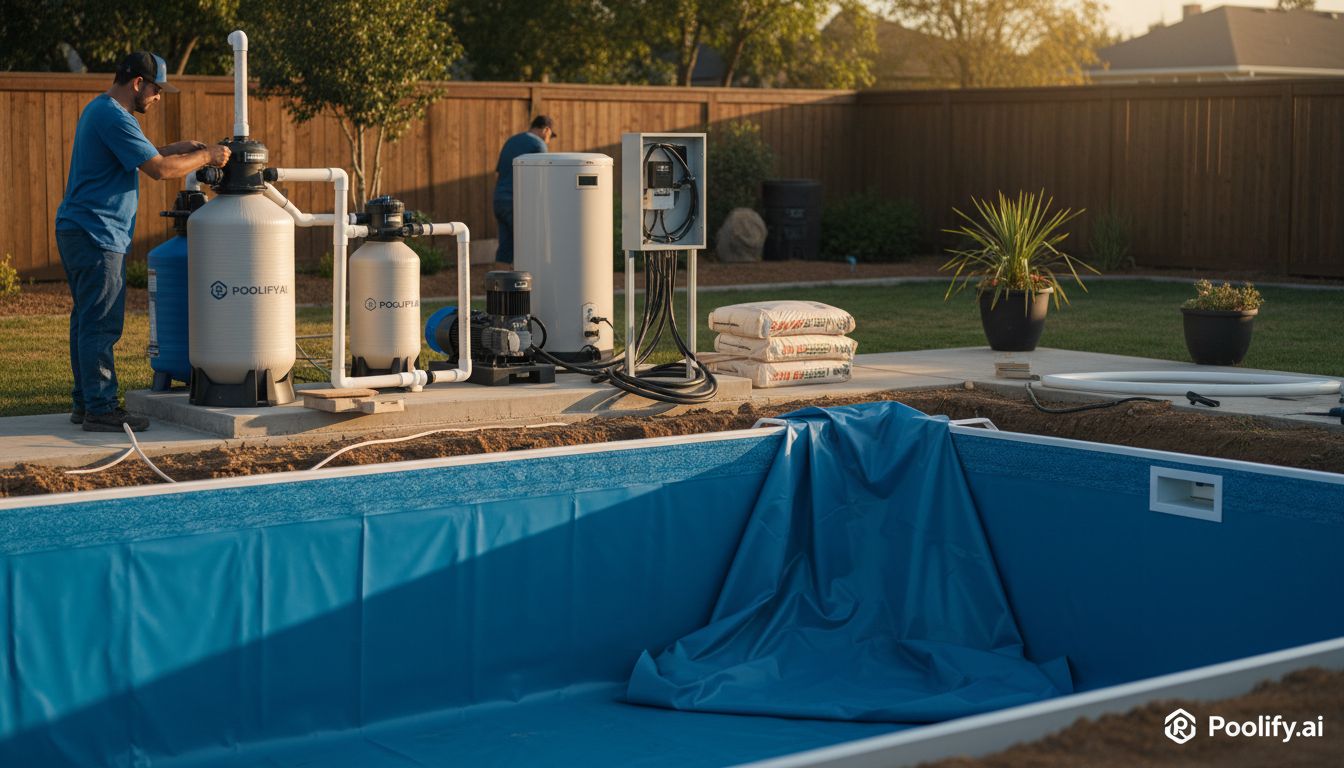
Beyond the pool structure itself, essential equipment contributes substantially to the total vinyl liner pool cost. Filtration systems range from $1,500 for basic sand filters to $3,500 for advanced cartridge or diatomaceous earth systems. Pool pumps cost between $800 and $2,500, with variable-speed models commanding premium prices but offering significant energy savings over time.
Heating systems represent optional but popular additions, with costs varying widely by technology. Gas heaters range from $2,000 to $4,500 installed, while heat pumps cost $3,500 to $6,000 but operate more efficiently in moderate climates. Solar heating systems require $3,000 to $7,000 upfront but eliminate ongoing fuel costs, making them cost-effective for long-term ownership.
Automation systems that control filtration, heating, and chemical distribution range from $1,500 for basic timers to $5,000 for sophisticated smartphone-controlled systems. Salt chlorination systems, increasingly popular for their convenience and gentler water quality, add $1,800 to $3,500 to the initial vinyl liner pool cost. These systems reduce ongoing chemical expenses while providing more consistent sanitization.
Energy-Efficient Equipment Considerations
Investing in energy-efficient equipment increases upfront costs but substantially reduces operating expenses. Variable-speed pumps cost $1,200 to $2,500 compared to $500 to $900 for single-speed models, yet they typically reduce energy consumption by 50-75%. According to the U.S. Department of Energy, pool pumps can account for significant household energy use, making efficiency upgrades financially advantageous.
LED lighting systems cost $800 to $2,000 installed but consume 75% less energy than traditional incandescent pool lights while lasting significantly longer. When calculating the complete vinyl liner pool cost, factoring in these efficiency upgrades provides a more accurate picture of total ownership expenses over the pool’s lifetime.
Decking and Surrounding Hardscape Expenses
Pool decking represents a necessary component often overlooked when budgeting for vinyl liner pool cost. Concrete decking, the most economical option, ranges from $6 to $15 per square foot installed. For a typical pool requiring 600-800 square feet of decking, expect to invest $4,500 to $12,000. Stamped or decorative concrete increases costs to $12 to $25 per square foot.
Pavers offer enhanced aesthetics and cooler surface temperatures, costing $15 to $30 per square foot installed. Natural stone represents the premium option at $25 to $50 per square foot, providing unmatched beauty but requiring the highest investment. The decking material choice should complement your home’s architecture while fitting within your overall budget constraints.
Additional hardscape elements like retaining walls, landscaping, fencing, and pathways can add $5,000 to $20,000 to the project. Many municipalities require pool fencing for safety compliance, with costs ranging from $1,500 to $5,000 depending on materials and perimeter length. These surrounding features significantly impact the final vinyl liner pool cost but enhance both safety and aesthetic appeal.
Annual Maintenance and Operating Costs
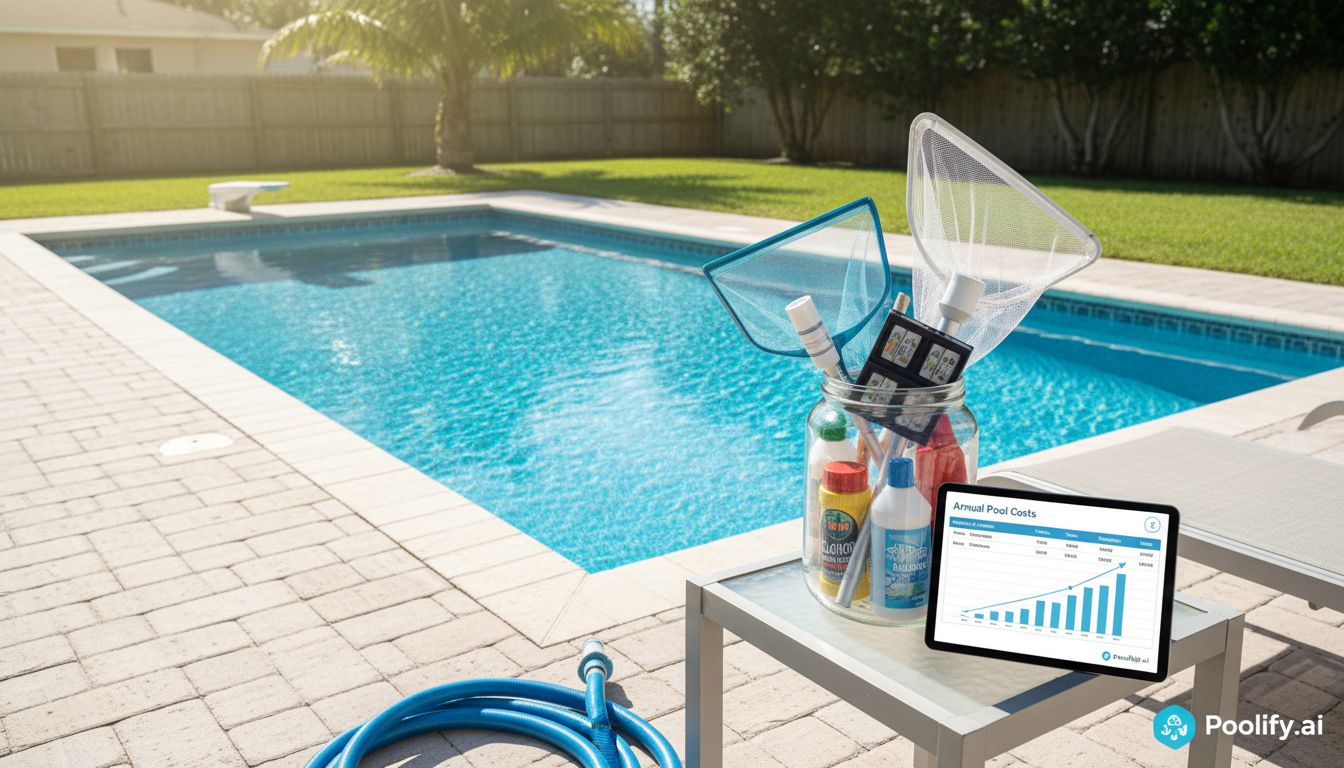
Ongoing maintenance represents a crucial consideration when evaluating the true vinyl liner pool cost over time. Annual chemical expenses typically range from $300 to $800, depending on pool size, usage frequency, and water quality. Chlorine, pH adjusters, algaecides, and shock treatments constitute the primary chemical needs throughout the swimming season.
Energy costs for running pumps, heaters, and other equipment vary by region and usage patterns but typically range from $500 to $1,800 annually. Variable-speed pumps and solar heating can reduce these expenses substantially. Water costs for filling and topping off the pool add another $100 to $300 per year in most areas, with higher rates in drought-prone regions.
Professional maintenance services cost $100 to $200 monthly during swimming season if you prefer outsourcing routine care. Many homeowners handle basic maintenance themselves, investing $500 to $1,000 annually in testing kits, cleaning tools, and equipment. For detailed cleaning strategies that minimize these costs, explore our expert pool cleaning guide with practical techniques.
Winterization and Seasonal Costs
In regions requiring winterization, closing costs range from $200 to $500 for professional service or $100 to $200 for DIY with proper supplies. Winter covers cost $150 to $600 depending on quality and pool size. Spring opening services charge similar rates, with professional assistance ensuring proper startup procedures that protect your vinyl liner investment.
Year-round maintenance in warmer climates eliminates winterization but extends operating costs throughout the year. The cumulative vinyl liner pool cost for tropical regions may actually exceed that of seasonal climates when accounting for twelve months of chemical, energy, and maintenance expenses rather than six to eight months.
Repair and Unexpected Expense Planning
Despite careful maintenance, occasional repairs contribute to the lifetime vinyl liner pool cost. Minor liner patches for small tears or punctures cost $100 to $300 when handled promptly. Delayed repairs often escalate into larger problems requiring more extensive liner replacement. Pump repairs range from $150 to $500, while complete pump replacement costs $800 to $2,500.
Filter repairs typically cost $100 to $400, though complete replacement becomes necessary every 5-10 years at $1,500 to $3,500 depending on system type. Heater repairs range from $200 to $800, with component replacements like heat exchangers costing $500 to $1,500. Maintaining a repair reserve fund of $500 to $1,000 annually helps cover these unexpected expenses without financial stress.
Plumbing leaks represent potentially serious issues requiring immediate attention. Minor leak repairs cost $200 to $600, while major plumbing work involving excavation can reach $1,500 to $4,000. Early detection through regular inspections minimizes repair costs and prevents water waste that increases utility bills.
Insurance and Liability Considerations
Pool ownership typically increases homeowners insurance premiums by $50 to $200 annually, depending on coverage levels and liability limits. Some insurers require specific safety features like fencing, covers, or alarms to maintain coverage. Umbrella liability policies provide additional protection beyond standard homeowners coverage, costing $150 to $300 annually for $1-2 million in coverage.
These insurance costs represent an often-overlooked component of the total vinyl liner pool cost but provide essential financial protection. Liability concerns make adequate coverage non-negotiable for responsible pool ownership, protecting your assets from potential accident-related claims.
Cost-Saving Strategies for Vinyl Pool Ownership
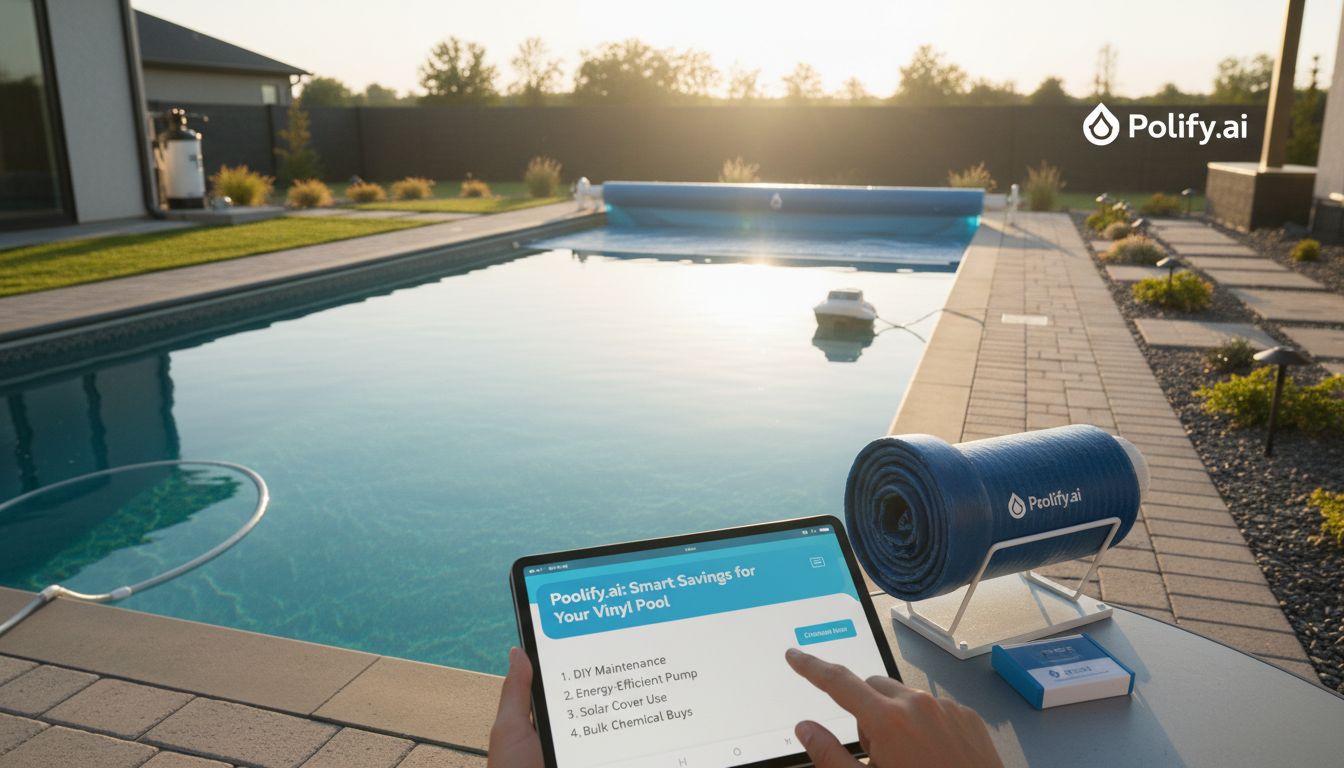
Strategic planning significantly reduces the overall vinyl liner pool cost without compromising quality or enjoyment. Timing your installation during off-season months (late fall through early spring) often yields 10-20% discounts as contractors seek to maintain steady work. Obtaining multiple detailed quotes from licensed contractors ensures competitive pricing and helps identify outliers.
Choosing simpler pool shapes and standard sizes reduces both initial installation and future liner replacement costs. Rectangular or oval configurations use materials more efficiently than complex custom shapes. Standard liner sizes benefit from competitive manufacturing pricing, while custom shapes require specialized production that increases costs by 20-40%.
Handling routine maintenance yourself rather than hiring services saves $1,200 to $2,400 annually. Learning proper chemical balancing, cleaning techniques, and basic troubleshooting requires modest time investment but delivers substantial savings. Quality testing kits cost $50 to $150 but enable precise chemical management that extends liner life and reduces product waste.
Equipment Efficiency Upgrades
Investing in energy-efficient equipment reduces operating costs substantially over time. Variable-speed pumps, despite higher upfront costs, typically pay for themselves within 2-4 years through energy savings. Pool covers reduce heating costs by 50-70% while minimizing water evaporation and chemical consumption, saving $500 to $1,200 annually.
LED lighting, timer systems, and automation reduce unnecessary equipment runtime and energy waste. These efficiency measures lower the cumulative vinyl liner pool cost over the pool’s lifetime, making them financially advantageous despite initial investment requirements. Solar heating eliminates ongoing fuel costs entirely in suitable climates, providing free heating after the initial installation investment.
Comparing Vinyl Liner Pool Cost to Alternative Pool Types
Understanding how vinyl liner pool cost compares to alternatives helps homeowners make informed decisions. Fiberglass pools typically cost $40,000 to $85,000 installed, offering faster installation and lower maintenance but limited size and shape options. The smooth gelcoat surface resists algae better than vinyl but requires eventual resurfacing every 15-20 years at $10,000 to $20,000.
Concrete pools represent the premium option, costing $50,000 to $150,000 or more for custom designs. While offering unlimited design flexibility and durability, concrete pools require acid washing every 3-5 years ($500-$800) and complete resurfacing every 10-15 years ($10,000-$25,000). Their rough surfaces consume more chemicals and require more intensive cleaning than vinyl liners.
When evaluating total cost of ownership over 20 years, vinyl pools often prove most economical despite periodic liner replacements. Assuming three liner replacements at $6,000 each ($18,000 total) over 20 years, vinyl pools still cost less than concrete resurfacing or fiberglass renovation. Lower initial investment and reduced maintenance complexity make vinyl an attractive option for budget-conscious homeowners.
Resale Value Considerations
Pool type impacts home resale value differently across markets. Vinyl pools generally add $20,000 to $40,000 to home value in pool-friendly markets, though this rarely equals the installation cost. Concrete pools may command slightly higher premiums in luxury markets, while fiberglass pools appeal to buyers seeking low-maintenance options.
The condition of the liner at sale time significantly affects perceived value. A recently replaced liner presents as a selling advantage, while an aging liner may prompt buyer concerns about immediate replacement costs. Maintaining detailed maintenance records demonstrates responsible ownership and can enhance buyer confidence regardless of pool type.
Frequently Asked Questions About Vinyl Liner Pool Cost
How much does it cost to replace a vinyl pool liner in 2026?
Vinyl pool liner replacement in 2026 costs between $4,000 and $8,500 including professional installation. Material costs range from $2,000 to $5,000 depending on liner thickness and design complexity, while installation labor adds $2,000 to $3,500. Premium features like custom patterns or thicker mil ratings increase the total vinyl liner pool cost for replacement.
What factors most significantly impact vinyl liner pool cost?
Pool size represents the primary cost driver, with larger pools requiring more materials and labor. Shape complexity affects both initial installation and future liner replacement expenses, as custom configurations require specialized manufacturing. Site conditions including terrain challenges, soil type, and accessibility influence excavation and construction costs. Equipment choices and feature additions like heating, automation, and lighting substantially impact the final investment.
How long do vinyl pool liners typically last?
Quality vinyl pool liners last 7-12 years with proper maintenance and care. Thicker liners (27-30 mil) generally outlast standard 20 mil options by 2-4 years. Factors affecting longevity include chemical balance maintenance, UV exposure, usage intensity, and climate conditions. Using pool covers and maintaining proper water chemistry can extend liner life toward the upper end of this range, reducing the frequency of replacement expenses.
Are vinyl liner pools cheaper to maintain than concrete pools?
Yes, vinyl liner pools typically cost 20-30% less to maintain annually than concrete pools. The smooth vinyl surface resists algae growth better than porous concrete, reducing chemical consumption. Vinyl pools require less intensive cleaning and avoid the periodic acid washing necessary for concrete surfaces. However, vinyl pools require complete liner replacement every 7-12 years, while concrete pools need resurfacing every 10-15 years at higher costs.
Can I install a vinyl liner pool myself to reduce costs?
While DIY vinyl pool kits exist and can reduce costs by $10,000 to $20,000, installation requires significant construction knowledge, proper equipment, and substantial time investment. Excavation, plumbing, electrical work, and liner installation demand expertise to avoid costly mistakes. Most homeowners benefit from professional installation that includes warranties and ensures proper construction. Consider DIY only if you possess relevant construction experience and can dedicate several weeks to the project.
Key Takeaways
- Initial vinyl liner pool cost in 2026 ranges from $25,000 to $65,000 for complete installation, making vinyl pools the most budget-friendly inground option compared to fiberglass and concrete alternatives.
- Liner replacement every 7-12 years costs $4,000 to $8,500, representing the most significant ongoing expense that distinguishes vinyl pools from other types requiring different long-term maintenance.
- Annual operating costs typically range from $1,000 to $3,000 including chemicals, energy, water, and routine maintenance, with potential savings through energy-efficient equipment and DIY maintenance approaches.
- Strategic decisions about pool size, shape, and equipment substantially impact total costs, with simpler rectangular designs and energy-efficient systems providing the best long-term value for budget-conscious homeowners.
- Total 20-year ownership costs for vinyl pools remain lower than alternatives despite periodic liner replacements, making them an economically sound choice when considering both initial investment and cumulative maintenance expenses.
See Your Dream Pool in Your Actual Backyard
Upload a photo and get an AI-designed pool visualization in 10 seconds. 3 free designs, no login required.
Try Poolify Free →Conclusion
Understanding the complete vinyl liner pool cost picture empowers homeowners to make confident decisions about their backyard investment. From initial installation ranging from $25,000 to $65,000 through periodic liner replacements every 7-12 years, vinyl pools offer the most accessible entry point into pool ownership. The combination of lower upfront costs, manageable maintenance requirements, and predictable replacement schedules makes vinyl an attractive option for families seeking affordable aquatic recreation.
Strategic planning significantly impacts long-term ownership costs. Choosing appropriate pool sizes, investing in energy-efficient equipment, maintaining proper water chemistry, and handling routine maintenance yourself can reduce cumulative expenses by thousands of dollars over the pool’s lifetime. While vinyl liners require periodic replacement, this cost remains substantially lower than concrete resurfacing or major fiberglass repairs.
The vinyl liner pool cost represents not just a financial investment but an enhancement to your lifestyle and property. By thoroughly understanding each expense component and implementing cost-saving strategies, you can enjoy years of backyard enjoyment without unexpected financial stress. Whether you’re planning your first pool installation or preparing for liner replacement, informed decision-making ensures your investment delivers maximum value and satisfaction throughout 2026 and beyond.
References
- U.S. Census Bureau – Construction Data: https://www.census.gov/construction/c30/c30index.html
- U.S. Department of Energy – Swimming Pool Covers: https://betterbuildingssolutioncenter.energy.gov/sites/default/files/attachments/Pool%20efficiency_.pdf
