
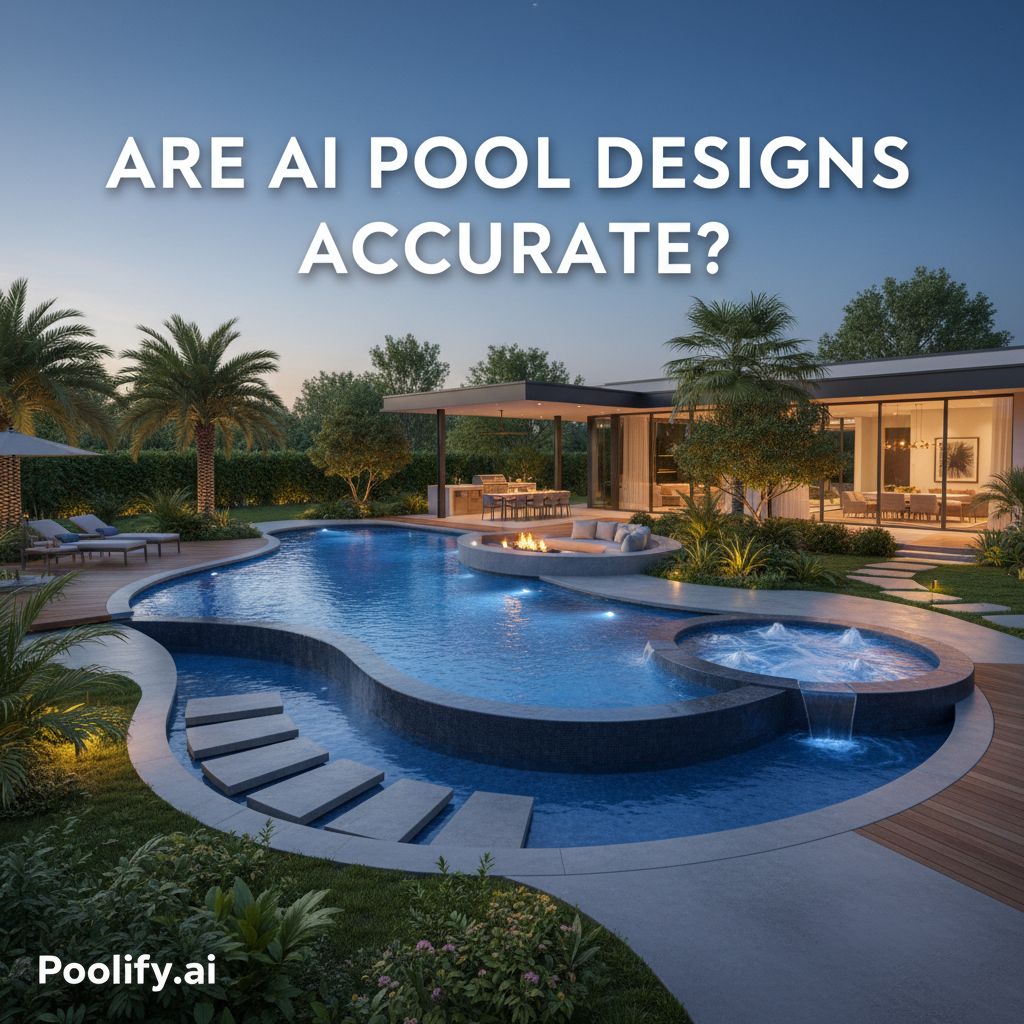
AI pool designs are accurate enough for planning, comparison, and decision-making — but they are not meant to replace professional engineering or construction drawings. Understanding what AI pool designs are accurate for (and what they are not) helps homeowners use these tools correctly and avoid unrealistic expectations.
This guide explains how accurate AI pool designs are, where they add the most value, and how to use them safely during the planning process.
What “Accuracy” Means in Pool Design
Accuracy depends on the stage of the project.
Different types of accuracy
- Conceptual accuracy: scale, placement, proportions, layout
- Visual accuracy: how the pool looks in the yard
- Technical accuracy: measurements, engineering, code compliance
AI pool design tools focus on conceptual and visual accuracy, not technical engineering accuracy.
Where AI Pool Designs Are Accurate
AI pool designs perform very well during early planning.
AI pool designs are accurate for
- Comparing pool sizes
- Understanding proportions in the yard
- Evaluating placement options
- Exploring different shapes
- Identifying layout issues early
Seeing a pool placed into your actual backyard provides clarity that sketches and descriptions cannot.
Where AI Pool Designs Are Not Intended to Be Exact
AI tools are not a substitute for professional plans.
AI pool designs are not meant for
- Final dimensions or measurements
- Structural engineering
- Plumbing and electrical layouts
- Permit submissions
- Construction-ready drawings
These elements must always be handled by licensed professionals.
Why Conceptual Accuracy Matters Most
Most costly mistakes happen before technical plans exist. Pools that feel too large, poorly placed, or awkwardly shaped are usually the result of early design decisions, not construction errors.
Conceptual accuracy helps you:
- Avoid oversized or undersized pools
- Choose better layouts
- Reduce redesigns later
- Communicate clearly with builders
AI excels at this stage.
How AI Pool Designs Compare to Traditional Methods
Traditional design methods often rely on imagination or static drawings.
Traditional approaches
- 2D sketches
- CAD-style plans
- Inspiration photos from other properties
AI-based visualization
- Shows real scale in your yard
- Allows side-by-side comparisons
- Makes tradeoffs easier to see
- Reduces assumptions
AI does not replace professional plans, but it improves early decision-making.
Factors That Affect AI Design Accuracy
The quality of the output depends on the input.
Accuracy improves when
- Backyard photos are clear
- Perspective is realistic
- Multiple options are explored
- Designs are reviewed comparatively
AI designs should be treated as exploratory concepts, not final answers.
Common Misunderstandings About Accuracy
“If it looks right, it must be buildable”
Visual accuracy does not guarantee structural feasibility.
“AI designs eliminate professional input”
They reduce uncertainty, not professional involvement.
“AI designs are final designs”
They are starting points meant to be refined.
How Builders Use AI-Based Concepts
Builders often use AI-generated concepts as a reference rather than a blueprint.
AI designs help builders:
- Understand homeowner preferences
- Speed up proposal discussions
- Reduce revisions
- Align expectations early
Clear concepts lead to smoother collaboration.
How AI Pool Design Tools Are Best Used
AI pool design tools work best as part of a phased process.
Recommended workflow
- Use AI to explore layout and placement
- Narrow down preferred designs
- Discuss concepts with professionals
- Convert concepts into engineered plans
This approach maximizes accuracy where it matters most.
Key Takeaways
- AI pool designs are accurate for layout and visualization
- They are not intended for engineering or permits
- Conceptual accuracy prevents costly mistakes
- AI improves early decision-making
- Professional plans are still required for construction
AI pool designs are most accurate where homeowners need help the most — understanding how a pool will actually fit and feel in their backyard before building begins.