
Installing a swimming pool represents one of the most significant investments you’ll make in your home, and understanding the complete financial picture is essential before breaking ground. This pool installation cost guide provides a comprehensive breakdown of expenses you’ll encounter in 2026, from initial excavation to final landscaping touches. Whether you’re considering an inground concrete pool or an above-ground option, knowing what to expect financially helps you make informed decisions and avoid budget-busting surprises during construction.
The average pool installation in 2026 ranges from $35,000 to $100,000 for inground pools, while above-ground options start around $3,000 to $15,000. However, these figures only tell part of the story. This pool installation cost guide will walk you through every expense category, hidden costs, and money-saving strategies that experienced pool owners wish they’d known before starting their projects.
Understanding the Primary Pool Installation Cost Categories
Before diving into specific numbers, it’s important to understand how pool installation costs break down into distinct categories. Each component contributes significantly to your final budget, and knowing these divisions helps you allocate funds appropriately and identify potential areas for cost savings.
Pool Type and Material Selection
Your choice of pool type represents the single largest cost factor in any installation project. Concrete or gunite pools typically cost between $50,000 and $100,000, offering complete customization and durability that lasts decades. Fiberglass pools range from $40,000 to $85,000 and provide faster installation with lower maintenance requirements. Vinyl liner pools fall in the $35,000 to $65,000 range, offering an economical middle ground with periodic liner replacement needs every 7-10 years.
According to the U.S. Census Bureau’s construction data, residential pool construction has increased by 23% since 2024, driving material costs upward while simultaneously improving installation efficiency. This pool installation cost guide reflects these current market conditions to give you accurate 2026 pricing expectations.
Excavation and Site Preparation
Site preparation costs vary dramatically based on your property’s characteristics. Standard excavation for an average-sized pool runs $3,000 to $8,000, but rocky terrain, high water tables, or difficult access can double these expenses. Soil testing, required in most jurisdictions, adds $500 to $1,500 to your budget but prevents costly surprises during excavation.
Properties with slopes require additional grading work, potentially adding $2,000 to $10,000 depending on severity. Tree removal, if necessary, costs $500 to $2,000 per tree. Smart planning during site selection can minimize these expenses significantly, making this an important consideration in your pool installation cost guide planning phase.
Pool Installation Cost Guide: Size and Depth Considerations
Pool dimensions directly impact installation costs, with pricing typically calculated per square foot or by total project scope. Understanding how size affects your budget helps you find the optimal balance between your desires and financial constraints.
Standard Size Ranges and Pricing
Small pools measuring 10×20 feet or 12×24 feet cost approximately $35,000 to $55,000 for inground installations. Medium pools at 14×28 feet or 16×32 feet range from $55,000 to $75,000. Large pools exceeding 18×36 feet or featuring custom shapes start at $75,000 and can exceed $150,000 with premium features.
Depth significantly influences excavation and structural requirements. Standard depths of 3.5 to 5.5 feet cost less than pools with deep ends exceeding 8 feet, which require additional structural engineering and materials. Diving pools with 9-foot deep ends add $10,000 to $20,000 to standard installation costs.
Custom Shapes and Design Features
Rectangular pools represent the most economical shape option, while kidney-shaped, freeform, or geometric designs increase costs by 15% to 30%. Each custom curve or angle requires additional formwork, materials, and labor hours. However, these designs often better complement your landscape and provide aesthetic value that justifies the premium.
Tanning ledges, beach entries, and built-in spas add $5,000 to $25,000 depending on complexity. These features enhance functionality and appeal but should be included in your initial pool installation cost guide calculations rather than added as afterthoughts, which typically costs more.
Essential Equipment and System Costs
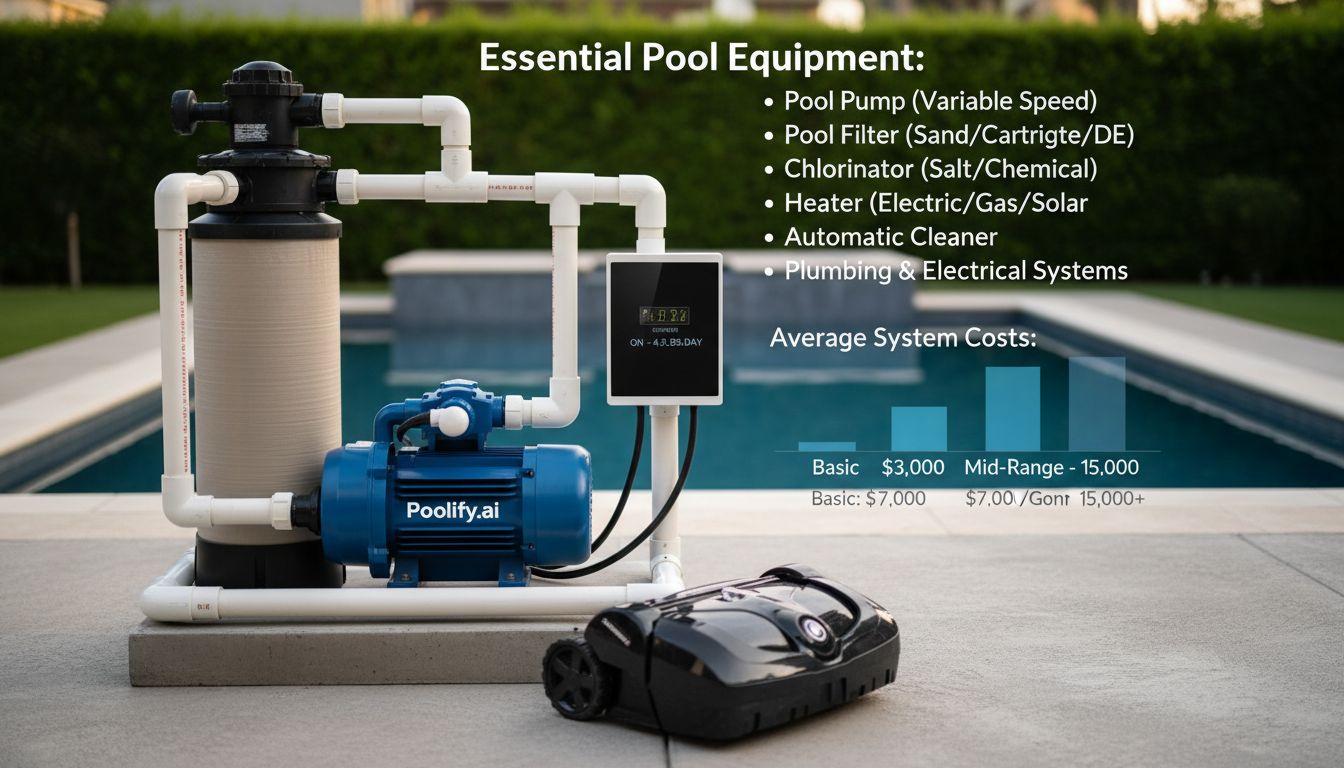
Beyond the pool structure itself, various mechanical systems and equipment are necessary for proper operation and maintenance. These components represent significant expenses that many homeowners underestimate when initially budgeting for pool installation.
Filtration and Circulation Systems
Pool pumps range from $800 to $2,500, with variable-speed models costing more upfront but reducing energy costs by up to 75% over time. Filters cost $500 to $2,000 depending on type—sand filters being most economical, cartridge filters offering middle-ground pricing, and diatomaceous earth (DE) filters providing superior filtration at premium prices.
Circulation systems including plumbing, returns, and skimmers add $2,000 to $5,000 to installation costs. Proper sizing ensures efficient water circulation, preventing stagnant areas and reducing chemical requirements. Undersizing these systems to save money creates ongoing maintenance headaches and higher operational costs.
Heating and Temperature Control
Pool heaters extend your swimming season significantly, particularly in regions with cooler climates. Gas heaters cost $2,000 to $4,500 and heat water quickly but have higher operational costs. Electric heat pumps range from $3,500 to $6,500, offering energy-efficient heating in moderate climates. Solar heating systems cost $3,000 to $8,000 upfront with minimal ongoing expenses, making them increasingly popular in sunny regions.
For comprehensive guidance on maintaining optimal pool conditions year-round, explore our complete pool maintenance resource that covers seasonal care strategies.
Finishing Touches and Surface Materials
The interior surface of your pool affects both aesthetics and long-term maintenance requirements. This section of our pool installation cost guide examines various finishing options and their cost implications.
Interior Surface Options
Plaster remains the most economical interior finish at $3 to $5 per square foot, lasting 7-15 years with proper maintenance. Aggregate finishes combining plaster with pebbles, quartz, or glass beads cost $7 to $15 per square foot but provide superior durability and visual appeal lasting 15-25 years.
Tile finishes represent premium options at $15 to $35 per square foot, offering unlimited design possibilities and extreme durability. Many pool owners combine materials, using tile for waterlines and steps while finishing the main pool surface with aggregate, balancing aesthetics with budget considerations.
Coping and Decking Materials
Pool coping, the cap along the pool edge, costs $30 to $100 per linear foot depending on material selection. Concrete and pavers offer economical options, while natural stone provides premium aesthetics at higher prices. Your coping choice should complement your decking material for cohesive design.
Deck materials significantly impact your total investment. Concrete decking costs $6 to $15 per square foot, pavers range from $10 to $25 per square foot, and natural stone runs $20 to $50 per square foot. Most installations include 300-600 square feet of decking, translating to $1,800 to $30,000 depending on material and area covered.
Hidden Costs in Your Pool Installation Cost Guide
Experienced pool owners consistently report that unexpected expenses represent one of their biggest challenges during installation. This section identifies commonly overlooked costs that should be included in your comprehensive pool installation cost guide budget.
Permits and Inspections
Building permits for pool installation cost $500 to $2,500 depending on your municipality and project scope. These permits ensure your pool meets local safety codes and zoning requirements. Electrical permits for pool equipment wiring add another $200 to $500. Some jurisdictions require multiple inspections throughout construction, each potentially carrying separate fees.
Homeowners association (HOA) approval, if applicable, may require architectural review fees of $100 to $500. Some HOAs impose specific design restrictions that could affect your plans and budget. Verify all regulatory requirements before finalizing your pool installation cost guide budget.
Utility Connections and Upgrades
Electrical service upgrades frequently accompany pool installations, particularly for homes with older electrical systems. Running dedicated circuits for pool equipment costs $1,000 to $3,000, while upgrading your main electrical panel adds $1,500 to $4,000. These expenses ensure safe operation and prevent circuit overloads.
Water filling costs vary by location but typically range from $80 to $250 for an average pool. Properties using well water might need to rent a water truck for faster filling, costing $400 to $800. Gas line extensions for pool heaters add $500 to $2,000 depending on distance from your main line.
Landscaping Restoration and Fencing
Pool installation inevitably disrupts surrounding landscape. Budget $2,000 to $8,000 for landscaping restoration, including sod replacement, plant installation, and grading repairs. Creating a cohesive poolscape with strategic plantings, lighting, and hardscaping can add $5,000 to $20,000 but dramatically enhances your outdoor environment.
Safety fencing is legally required in most jurisdictions, costing $1,500 to $10,000 depending on materials and perimeter length. Chain-link fencing provides economical compliance, while ornamental iron, glass panels, or custom wood designs offer aesthetic appeal at premium prices. According to Consumer Product Safety Commission guidelines, proper pool barriers prevent tragic accidents and are essential safety investments.
Additional Features and Upgrades
Once you’ve covered basic installation costs, numerous optional features can enhance your pool’s functionality, aesthetics, and enjoyment. This pool installation cost guide section helps you prioritize upgrades based on value and budget availability.
Lighting Systems
LED pool lighting has become standard in 2026, offering energy efficiency and color-changing capabilities. Basic lighting packages with 2-4 lights cost $1,000 to $2,500, while elaborate systems with multiple colors, zones, and automation run $3,000 to $8,000. Landscape lighting around your pool area adds $1,500 to $5,000, creating ambiance and improving nighttime safety.
Water Features and Entertainment
Waterfalls range from simple sheer descents at $1,500 to elaborate rock formations costing $10,000 or more. Deck jets shooting water arcs into your pool cost $500 to $1,500 per jet. Bubblers and fountains add $800 to $3,000 depending on design complexity.
Slides vary dramatically in price, from simple straight slides at $1,500 to elaborate curved models exceeding $10,000. Diving boards cost $500 to $2,000 plus installation. Swimming pool basketball hoops and volleyball nets provide affordable entertainment at $200 to $800.
Automation and Smart Controls
Pool automation systems allow remote control of pumps, heaters, lights, and chemical feeders from your smartphone. Basic automation packages start around $1,500, while comprehensive systems cost $3,000 to $6,000. These systems improve convenience and can reduce operational costs through optimized scheduling and monitoring.
Automatic pool covers provide safety and energy savings, costing $5,000 to $15,000 depending on pool size and cover type. They reduce heating costs by preventing heat loss and minimize debris accumulation, reducing maintenance time and chemical usage.
Ongoing Operational Costs Beyond Installation
A complete pool installation cost guide must address expenses extending beyond construction. Understanding ongoing operational costs helps you budget accurately for long-term pool ownership.
Monthly and Annual Maintenance
Chemical treatments cost $50 to $150 monthly depending on pool size and usage. Water testing kits and supplies add another $20 to $40 monthly. Professional maintenance services range from $100 to $300 monthly, handling chemical balancing, cleaning, and equipment checks.
Electricity for pumps and heaters adds $50 to $300 monthly to utility bills depending on equipment efficiency and usage patterns. Variable-speed pumps significantly reduce these costs compared to single-speed models. Heating costs vary dramatically by climate and heating method, ranging from negligible for solar systems to $200-500 monthly for gas heaters during peak season.
For detailed strategies to minimize these ongoing expenses, review our expert pool cleaning and maintenance tips that help reduce chemical usage and extend equipment lifespan.
Repair and Replacement Reserves
Pool equipment doesn’t last forever. Pumps typically need replacement every 8-12 years at $800 to $2,500. Heaters last 10-15 years, costing $2,000 to $6,500 to replace. Filters require replacement every 5-15 years depending on type, at $500 to $2,000. Setting aside $500 to $1,000 annually for eventual equipment replacement prevents financial stress when failures occur.
Surface refinishing represents another significant future expense. Plaster resurfacing costs $5,000 to $10,000 every 10-15 years, while aggregate finishes need attention every 15-25 years at $8,000 to $15,000. Vinyl liner replacement runs $3,000 to $5,000 every 7-10 years.
Money-Saving Strategies for Pool Installation
Strategic planning can significantly reduce your pool installation costs without sacrificing quality or safety. This pool installation cost guide section shares proven strategies for maximizing value.
Timing Your Installation
Pool contractors experience seasonal demand fluctuations, with spring and early summer representing peak season. Scheduling installation during fall or winter often yields 10-20% discounts as contractors seek to maintain steady work. However, weather delays become more likely during off-season construction in many regions.
Obtaining multiple quotes from reputable contractors ensures competitive pricing. Request at least three detailed estimates, comparing not just total costs but specific line items to identify where prices vary. Be cautious of quotes significantly below others, which may indicate cut corners or hidden fees emerging later.
Phasing Your Project
Consider installing your basic pool initially, then adding features like waterfalls, elaborate lighting, or extensive decking in subsequent years as budget allows. While this approach involves some redundant mobilization costs, it makes premium features financially accessible without compromising the core pool quality.
However, certain elements like plumbing for future water features or electrical conduits for additional lighting should be installed during initial construction. Adding these rough-ins costs minimally during construction but becomes expensive to retrofit later.
DIY Opportunities and Limitations
Certain tasks like landscaping, basic decking, or fence installation are suitable for capable DIY homeowners, potentially saving 30-50% on those specific components. However, pool excavation, plumbing, electrical work, and structural installation require professional expertise and licensing. Attempting these specialized tasks yourself risks costly mistakes, safety hazards, and code violations that complicate future home sales.
Financing Your Pool Installation
Most homeowners finance pool installations rather than paying cash upfront. Understanding your financing options helps you structure payments that fit your budget while minimizing interest costs.
Home Equity Options
Home equity loans and lines of credit typically offer the lowest interest rates for pool financing, with rates in 2026 ranging from 6% to 10% depending on creditworthiness. These options allow you to borrow against your home’s equity, with loan terms typically spanning 10-15 years. Interest may be tax-deductible if the pool qualifies as a home improvement, though you should consult a tax professional for guidance specific to your situation.
Personal Loans and Contractor Financing
Personal loans for pool installation carry higher interest rates, typically 8% to 15%, but don’t require home equity and often feature faster approval processes. Loan terms generally run 5-7 years with fixed monthly payments.
Many pool contractors offer financing programs through lending partners, sometimes featuring promotional periods with reduced or zero interest. Read terms carefully, as deferred interest programs can result in substantial charges if you don’t pay the full balance before the promotional period ends.
Pool Installation Cost Guide: Regional Considerations
Geographic location significantly impacts pool installation costs through labor rates, material availability, climate-related requirements, and local regulations. This section of our pool installation cost guide examines regional variations affecting your budget.
Climate-Driven Requirements
Northern climates require deeper excavation below frost lines, adding $2,000 to $5,000 to installation costs. Winterization becomes essential, requiring equipment and procedures that warm-climate pools don’t need. Conversely, southern locations may require additional cooling features or shade structures to make pools comfortable during peak summer heat.
Areas with high water tables need specialized drainage systems and structural reinforcement to prevent pool floating or shifting, potentially adding $5,000 to $15,000. Rocky terrain common in certain regions increases excavation costs substantially, sometimes doubling standard estimates.
Labor and Material Cost Variations
Labor rates vary significantly by region, with coastal and metropolitan areas typically charging 20-40% more than rural or inland locations. Material costs also fluctuate based on transportation distances and local availability. California and Northeast installations generally cost 15-30% more than similar projects in the Southeast or Midwest.
Local competition among contractors affects pricing as well. Markets with numerous established pool builders tend to offer more competitive rates than areas with limited options. However, prioritize contractor experience and reputation over price alone, as quality installation prevents costly problems throughout your pool’s lifespan.
Frequently Asked Questions
What is the average pool installation cost in 2026?
The average inground pool installation costs between $50,000 and $75,000 in 2026, including basic equipment, standard finishes, and minimal decking. This pool installation cost guide shows that final expenses vary significantly based on size, materials, features, and location. Above-ground pools cost substantially less, averaging $3,000 to $15,000 installed.
How long does pool installation take from start to finish?
Typical inground pool installation takes 8-12 weeks from excavation to completion, though timelines vary based on pool type, weather conditions, and contractor schedules. Fiberglass pools install fastest at 3-6 weeks, while custom concrete pools may require 12-16 weeks. Permit acquisition adds 2-6 weeks before construction begins.
Do pools increase home value enough to justify the cost?
Pools typically return 30-50% of installation costs in home value, varying by location and market conditions. In warm climates where pools are common, they may return 50-70% and make homes more marketable. In cooler regions, returns are often lower. View pools primarily as lifestyle investments rather than financial ones.
What hidden costs should I budget for beyond the quoted price?
This pool installation cost guide emphasizes budgeting an additional 15-25% beyond contractor quotes for permits ($500-2,500), landscaping restoration ($2,000-8,000), fencing ($1,500-10,000), electrical upgrades ($1,000-4,000), and initial chemical supplies ($200-500). These commonly overlooked expenses significantly impact total investment.
Should I install a pool myself to save money?
DIY pool installation is not recommended for inground pools due to complex excavation, plumbing, electrical, and structural requirements. Professional installation ensures proper construction, code compliance, and warranty coverage. However, capable homeowners can handle some finishing work like decking, landscaping, or fence installation to reduce overall costs by 10-15%.
Key Takeaways
- Budget comprehensively: This pool installation cost guide demonstrates that total costs extend well beyond the contractor’s quote, including permits, utilities, landscaping, fencing, and equipment that add 20-30% to base prices.
- Choose materials strategically: Pool type and materials represent your largest cost factors, with concrete pools costing $50,000-100,000, fiberglass $40,000-85,000, and vinyl $35,000-65,000. Balance upfront costs against long-term maintenance and durability.
- Plan for ongoing expenses: Monthly operational costs of $150-450 for chemicals, electricity, and maintenance, plus eventual equipment replacement and refinishing, require ongoing financial commitment beyond installation.
- Time your project wisely: Off-season installation during fall or winter can save 10-20% through contractor discounts, though weather delays become more likely in many regions.
- Prioritize professional installation: While some finishing work suits DIY efforts, core construction requires licensed professionals to ensure safety, code compliance, and warranty protection that protects your significant investment.
Conclusion
This comprehensive pool installation cost guide for 2026 provides the detailed financial information you need to plan your pool project confidently. Understanding the complete cost picture—from excavation through ongoing maintenance—prevents budget surprises and helps you make informed decisions about materials, features, and timing.
Remember that pool installation represents a significant investment in your lifestyle and property. While costs are substantial, proper planning and realistic budgeting ensure your project delivers years of enjoyment without financial stress. Take time to obtain multiple quotes, verify contractor credentials, and carefully consider which features matter most to your family.
By following the guidance in this pool installation cost guide, you’ll be well-prepared to navigate the installation process, make strategic decisions that maximize value, and create the backyard oasis you’ve envisioned. Start with a clear budget, communicate openly with contractors, and plan for both expected and unexpected expenses to ensure your pool project succeeds from groundbreaking to that first refreshing swim.
References
- U.S. Census Bureau – Construction Data and Housing Statistics
- Consumer Product Safety Commission – Pool Safety Guidelines and Requirements