
Understanding Your Pool Maintenance Cost Yearly in 2026
Owning a swimming pool brings endless enjoyment, but it also comes with ongoing financial responsibilities. The pool maintenance cost yearly has become a critical consideration for homeowners in 2026, with average expenses ranging from $1,200 to $1,800 for standard residential pools. Understanding these costs helps you budget appropriately and make informed decisions about professional services versus DIY maintenance. This comprehensive guide breaks down every expense category, reveals hidden costs, and provides actionable strategies to optimize your pool maintenance budget without compromising water quality or safety.
Whether you’re a new pool owner or looking to reduce your existing expenses, knowing the pool maintenance cost yearly empowers you to plan ahead and avoid financial surprises. From chemicals and equipment to energy consumption and repairs, we’ll explore every factor that influences your annual pool budget and show you how to maximize value while maintaining a sparkling, healthy swimming environment.
Breaking Down the Pool Maintenance Cost Yearly: Complete Expense Categories
The pool maintenance cost yearly encompasses several distinct categories that vary based on pool size, type, location, and usage patterns. Understanding each component helps you identify where your money goes and where you might find opportunities for savings.
Chemical Costs and Water Treatment
Chemical expenses typically represent the largest portion of your pool maintenance cost yearly, averaging $400 to $800 annually for a standard 20,000-gallon pool. Essential chemicals include chlorine or alternative sanitizers, pH balancers, alkalinity adjusters, calcium hardness increasers, and algaecides. The CDC recommends maintaining proper chemical balance to ensure safe swimming conditions and prevent waterborne illnesses.
Chlorine remains the most common sanitizer, with costs varying between liquid chlorine, tablets, and granular forms. Salt systems offer an alternative that converts salt to chlorine automatically, reducing manual chemical additions but requiring an initial investment in equipment. Your chemical consumption increases during peak swimming season when sunlight, heat, and bather load place greater demands on water sanitization.
Energy Expenses for Pumps and Heating
Energy costs contribute significantly to your pool maintenance cost yearly, with pump operation alone costing $300 to $600 annually depending on your electricity rates and pump efficiency. Modern variable-speed pumps can reduce energy consumption by 50-75% compared to single-speed models, offering substantial long-term savings despite higher upfront costs.
Pool heating adds considerably to energy expenses if you extend your swimming season. Gas heaters typically cost $200 to $400 monthly during operation, while heat pumps offer more efficient alternatives at $50 to $150 monthly. Solar heating systems minimize ongoing energy costs after installation but require suitable roof space and sun exposure.
Equipment Maintenance and Replacement
Regular equipment maintenance and eventual replacement form another component of your pool maintenance cost yearly. Filter cleaning supplies, pump basket replacements, and skimmer parts cost approximately $100 to $200 annually. Major equipment replacements occur periodically, with pumps lasting 8-12 years, filters 5-15 years depending on type, and heaters 10-15 years with proper maintenance.
Setting aside $200 to $400 yearly for an equipment replacement fund ensures you’re prepared when major components fail. This proactive approach prevents financial stress when expensive repairs become necessary and allows you to upgrade to more efficient models that reduce your long-term pool maintenance cost yearly.
Seasonal Variations in Pool Maintenance Cost Yearly
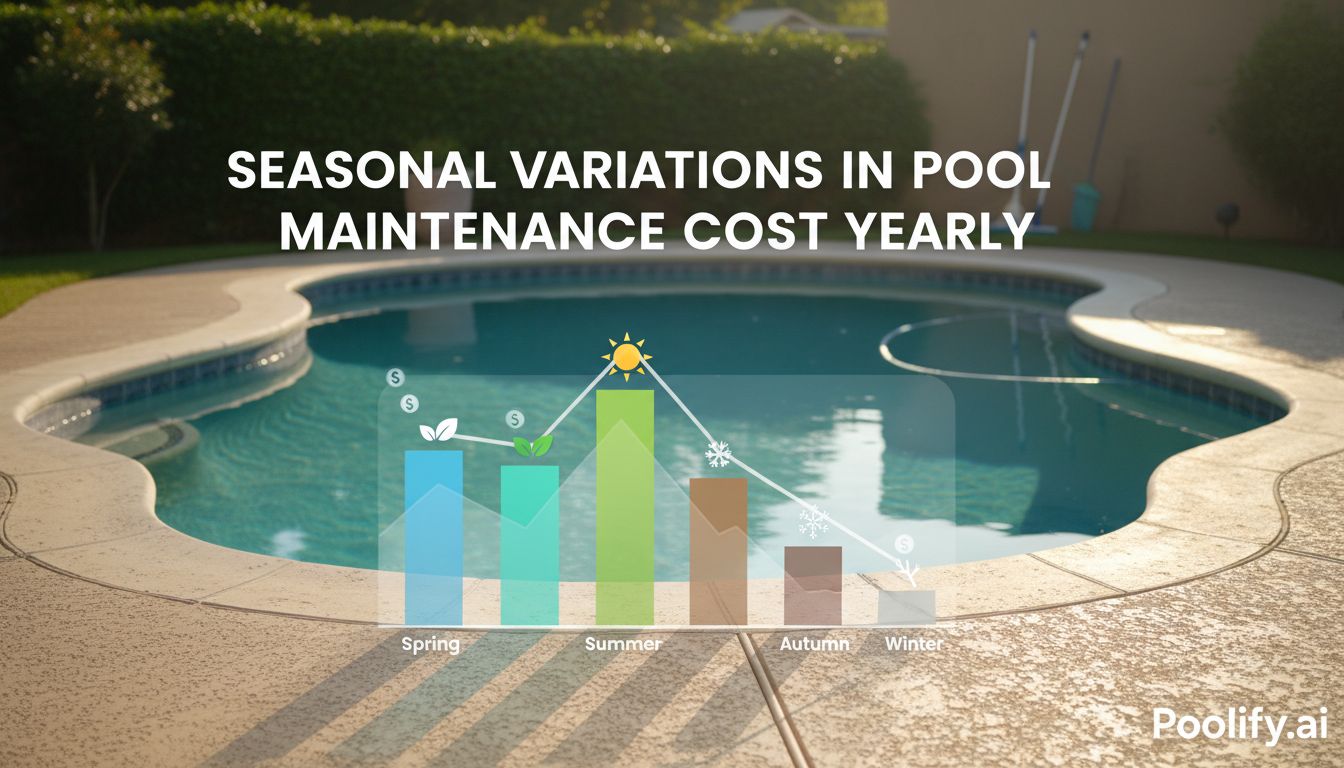
Your pool maintenance cost yearly fluctuates significantly across seasons, with summer months demanding the highest expenditures and winter requiring different maintenance approaches. Understanding these seasonal patterns helps you budget more accurately throughout the year.
Peak Season Expenses (Summer)
Summer represents the most expensive period for pool maintenance, accounting for 50-60% of your annual costs. Increased water temperature accelerates chemical consumption, with chlorine depleting faster in hot weather and bright sunlight. You’ll use more chemicals to combat algae growth, balance pH fluctuations, and accommodate higher bather loads during peak swimming months.
Water evaporation increases dramatically during summer, requiring more frequent refilling that adds to water bills and necessitates rebalancing chemicals. Your pump runs longer to maintain proper circulation and filtration, driving up electricity costs. Many pool owners increase their pool maintenance cost yearly budget by 40-50% during June through August to account for these elevated expenses.
Off-Season Maintenance Costs
Winter maintenance varies dramatically based on climate. In regions where pools remain open year-round, the pool maintenance cost yearly continues but at reduced levels due to decreased usage and slower chemical consumption. Running your pump fewer hours and maintaining lower chemical levels can reduce winter costs by 30-40% compared to summer months.
Cold-climate pool owners face winterization expenses including antifreeze, pool covers, and closing services if hiring professionals. A quality winter cover costs $100 to $500 and protects your investment while reducing spring opening costs. Professional winterization services range from $150 to $300 but ensure proper procedures that prevent freeze damage to equipment and plumbing.
DIY Versus Professional Services: Impact on Pool Maintenance Cost Yearly
Choosing between DIY maintenance and professional services dramatically affects your pool maintenance cost yearly. Each approach offers distinct advantages and cost implications that suit different homeowner situations and preferences.
Full DIY Maintenance Approach
Managing all pool maintenance yourself minimizes your pool maintenance cost yearly to approximately $800 to $1,200 annually for a standard residential pool. This includes chemicals, testing supplies, equipment maintenance, and utilities. You’ll need to invest time learning proper maintenance procedures, testing water chemistry regularly, and performing routine cleaning tasks.
DIY maintenance requires purchasing testing equipment, cleaning tools, and maintaining a chemical inventory. Initial setup costs for quality testing kits, telescoping poles, brushes, and vacuum equipment range from $200 to $400. However, these tools last multiple years, making the investment worthwhile for committed DIY pool owners. Check out our comprehensive pool cleaning tips for detailed guidance on maintaining your pool yourself.
Professional Pool Service Options
Professional pool service significantly increases your pool maintenance cost yearly but provides convenience, expertise, and peace of mind. Weekly service typically costs $80 to $150 monthly ($960 to $1,800 annually), with technicians handling chemical balancing, cleaning, and basic equipment checks. This doesn’t include chemicals, which some services include while others charge separately.
Full-service contracts covering all chemicals, cleaning, and minor repairs range from $150 to $300 monthly, bringing your total pool maintenance cost yearly to $1,800 to $3,600. While substantially more expensive than DIY, professional service ensures consistent maintenance, early problem detection, and expert handling of complex water chemistry issues that inexperienced owners might struggle with.
Hybrid Maintenance Strategies
Many homeowners adopt hybrid approaches that balance cost savings with professional expertise. You might handle routine tasks like skimming, brushing, and basic chemical additions while hiring professionals for monthly water testing, equipment inspections, and seasonal opening or closing. This hybrid model typically costs $1,200 to $1,600 annually, offering a middle ground between full DIY and complete professional service.
Hidden Costs That Increase Pool Maintenance Cost Yearly
Beyond obvious expenses, several hidden costs can unexpectedly inflate your pool maintenance cost yearly. Awareness of these factors helps you budget more accurately and avoid financial surprises.
Water and Sewer Charges
Water costs often get overlooked when calculating pool maintenance cost yearly, but they add up significantly. Initial filling requires 15,000 to 30,000 gallons depending on pool size, costing $50 to $150 in most municipalities. Ongoing evaporation and backwashing require adding 1,000 to 2,000 gallons monthly during summer, adding $150 to $300 annually to water bills.
Some municipalities charge sewer fees based on water usage, even though pool water doesn’t enter the sewer system. Installing a separate meter for outdoor water use can eliminate these charges, potentially saving $100 to $200 yearly. Contact your water utility to explore this option if it significantly impacts your pool maintenance cost yearly.
Leak Detection and Repair
Undetected leaks dramatically increase your pool maintenance cost yearly through wasted water, excess chemical usage, and potential structural damage. A small leak losing just one-quarter inch of water daily wastes approximately 3,750 gallons monthly, costing $50 to $75 in water alone plus additional chemicals needed to maintain proper balance.
Professional leak detection services cost $300 to $500 but quickly pay for themselves by identifying problems before they cause extensive damage. Simple bucket tests performed monthly help you detect leaks early, allowing prompt repairs that minimize impact on your annual pool maintenance budget.
Insurance and Liability Considerations
Pool ownership affects homeowners insurance premiums, typically increasing annual costs by $50 to $100. Some insurers require additional liability coverage due to pool-related injury risks. Installing required safety features like fencing, alarms, and covers may add $500 to $2,000 to initial costs, though these are typically one-time expenses rather than recurring elements of your pool maintenance cost yearly.
Reducing Your Pool Maintenance Cost Yearly: 10 Proven Strategies
Implementing smart strategies can significantly reduce your pool maintenance cost yearly without compromising water quality or enjoyment. These proven approaches help optimize expenses across all cost categories.
Strategy 1: Upgrade to Energy-Efficient Equipment
Replacing old single-speed pumps with variable-speed models reduces energy consumption by 50-75%, saving $200 to $400 annually. While variable-speed pumps cost $800 to $1,500, they typically pay for themselves within 3-4 years through energy savings. LED pool lights use 80% less energy than incandescent bulbs, further reducing your pool maintenance cost yearly.
Strategy 2: Maintain Proper Water Chemistry
Keeping water chemistry balanced prevents costly problems that inflate your pool maintenance cost yearly. Proper pH levels optimize chlorine effectiveness, reducing chemical waste. Regular testing and small adjustments cost less than correcting major imbalances that require large chemical doses and potentially damage equipment or surfaces.
Strategy 3: Use a Pool Cover
Quality pool covers reduce water evaporation by 90-95%, saving hundreds of gallons monthly and the chemicals needed to rebalance after refilling. Covers also reduce heating costs by 50-70% and minimize debris accumulation, decreasing cleaning time and filter strain. A solar cover costing $50 to $200 can reduce your pool maintenance cost yearly by $200 to $400.
Strategy 4: Optimize Pump Run Times
Running your pump only as long as necessary for proper circulation reduces energy costs without compromising water quality. Most pools require 8-12 hours of daily filtration during summer and 4-6 hours during cooler months. Using a programmable timer ensures consistent operation during off-peak electricity hours when rates are lower in areas with time-of-use pricing.
Strategy 5: Buy Chemicals in Bulk
Purchasing chemicals in larger quantities during off-season sales reduces your pool maintenance cost yearly by 20-30%. Chlorine tablets, shock treatments, and balancing chemicals store well when kept dry and sealed. Buying a season’s supply in spring often provides significant savings compared to purchasing small quantities throughout summer at peak prices.
Strategy 6: Perform Preventive Maintenance
Regular equipment maintenance prevents expensive repairs that dramatically increase your pool maintenance cost yearly. Cleaning pump baskets weekly, backwashing filters as needed, and inspecting equipment monthly identifies minor issues before they become major problems. Spending $50 to $100 annually on preventive maintenance saves hundreds in emergency repairs.
Strategy 7: Learn Basic Water Testing
Mastering water testing eliminates the need for frequent pool store visits and ensures you add only necessary chemicals. Quality test kits cost $30 to $100 and provide accurate readings for chlorine, pH, alkalinity, and other parameters. Testing twice weekly during summer and weekly during off-season prevents chemical waste and maintains optimal water balance.
Strategy 8: Minimize Water Features During Off-Peak Times
Waterfalls, fountains, and other features increase evaporation and energy consumption. Running these features only during swimming hours rather than continuously can reduce your pool maintenance cost yearly by $100 to $200. Programmable controls automate this process, ensuring features operate when you’re home to enjoy them.
Strategy 9: Maintain Proper Landscaping
Strategic landscaping around your pool reduces debris accumulation, decreasing cleaning time and filter strain. Keeping trees and shrubs trimmed prevents leaves from falling into the pool. Choosing low-debris plants near the pool area minimizes maintenance needs. This simple approach can reduce your annual pool maintenance cost yearly by decreasing chemical usage and extending filter life.
Strategy 10: Address Problems Promptly
Small problems quickly become expensive repairs if ignored. Cloudy water indicates filtration or chemical issues requiring immediate attention. Strange pump noises suggest bearing problems that cost $50 to fix early but $300 to $500 if the pump fails completely. Prompt action on minor issues prevents them from significantly increasing your pool maintenance cost yearly.
Pool Type and Size Impact on Pool Maintenance Cost Yearly
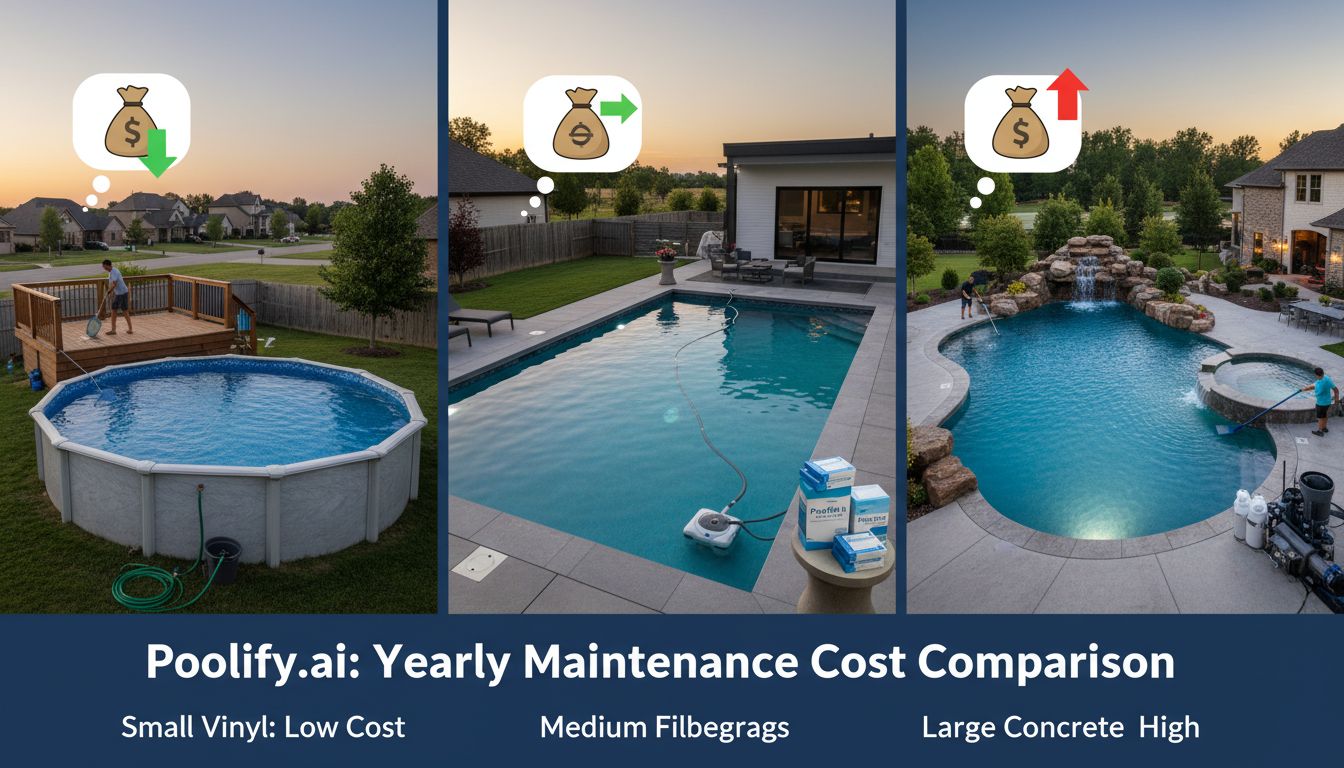
Your pool’s characteristics fundamentally influence maintenance expenses, with type, size, and features all affecting your pool maintenance cost yearly. Understanding these relationships helps set realistic budget expectations.
In-Ground Versus Above-Ground Pools
In-ground pools typically have higher pool maintenance cost yearly than above-ground pools due to larger volumes, more complex equipment, and additional features. A standard in-ground pool (15,000-30,000 gallons) costs $1,200 to $1,800 annually to maintain, while above-ground pools (5,000-15,000 gallons) average $600 to $1,200 yearly due to smaller volumes requiring fewer chemicals and less energy for circulation.
However, above-ground pools may require more frequent liner replacements every 5-7 years at $300 to $800, while in-ground pool surfaces last 10-15 years or longer. Factor these periodic costs into your long-term pool maintenance cost yearly calculations when comparing pool types.
Saltwater Versus Chlorine Pools
Saltwater pools reduce ongoing chemical costs by $200 to $400 annually compared to traditional chlorine pools, as the salt cell generates chlorine automatically from salt. However, salt cells require replacement every 3-5 years at $400 to $800, and salt systems are more expensive initially. Over a 5-year period, saltwater pools typically have similar or slightly lower pool maintenance cost yearly compared to traditional chlorine systems.
Saltwater pools also require monitoring and balancing, though less frequently than chlorine pools. Salt levels, pH, and alkalinity still need regular testing and adjustment. The gentler water quality appeals to many swimmers, making saltwater systems popular despite comparable long-term costs. Learn more about maintaining proper pool water chemistry for both system types.
Pool Size Considerations
Pool maintenance cost yearly scales with pool volume but not proportionally. Doubling pool size doesn’t double costs, as many expenses like equipment and labor remain relatively fixed. A 15,000-gallon pool might cost $1,000 annually to maintain, while a 30,000-gallon pool costs $1,500 rather than $2,000, as pump efficiency and chemical effectiveness improve with proper circulation in larger pools.
Regional Climate Effects on Pool Maintenance Cost Yearly
Geographic location and climate significantly influence your pool maintenance cost yearly through varying season lengths, temperature extremes, and environmental factors. Understanding regional considerations helps you budget appropriately for your specific situation.
Year-Round Pool Climates
Homeowners in warm climates like Florida, Southern California, and Arizona enjoy year-round pool use but face higher annual maintenance costs. Continuous operation means consistent chemical usage, energy consumption, and equipment wear. The pool maintenance cost yearly in these regions typically reaches $1,500 to $2,200 due to extended swimming seasons and constant water treatment needs.
However, these regions avoid winterization costs and don’t face freeze-related equipment damage. The ability to spread maintenance costs evenly throughout the year simplifies budgeting, though total expenses remain higher than seasonal-use regions when calculated annually.
Seasonal Pool Climates
Northern regions with distinct seasons see lower pool maintenance cost yearly, typically $1,000 to $1,500, due to 4-6 month operating seasons. Winterization and spring opening add $200 to $500 to annual costs, but reduced chemical usage and energy consumption during closed months offset these expenses.
Cold-climate pool owners must protect equipment from freeze damage through proper winterization procedures. Investing in quality winter covers and ensuring complete water drainage from equipment prevents costly spring repairs that could dramatically increase your pool maintenance cost yearly.
Environmental Factors
Local environmental conditions affect maintenance needs beyond temperature. Dusty or pollen-heavy regions require more frequent cleaning and filtration. Areas with hard water need additional chemicals to manage calcium levels. Regions prone to storms face increased debris accumulation and potential equipment damage. These factors can add $100 to $300 to your pool maintenance cost yearly depending on severity and frequency.
Frequently Asked Questions About Pool Maintenance Cost Yearly
What is the average pool maintenance cost yearly for a standard residential pool in 2026?
The average pool maintenance cost yearly for a standard 20,000-gallon residential pool ranges from $1,200 to $1,800 in 2026. This includes chemicals ($400-$800), energy costs ($300-$600), water ($150-$300), and equipment maintenance ($200-$400). Your actual costs vary based on pool size, type, location, usage patterns, and whether you perform DIY maintenance or hire professional services. Professional weekly service adds $960 to $1,800 annually to these baseline costs.
How can I significantly reduce my pool maintenance cost yearly without compromising water quality?
You can reduce your pool maintenance cost yearly by 30-40% through several strategies: upgrade to a variable-speed pump for $200-$400 annual energy savings, use a pool cover to reduce evaporation and heating costs by $200-$400 yearly, buy chemicals in bulk during off-season sales for 20-30% savings, perform DIY maintenance instead of hiring weekly service to save $960-$1,800 annually, and maintain proper water chemistry to prevent costly corrections. These approaches maintain excellent water quality while optimizing expenses.
Does pool size significantly affect the pool maintenance cost yearly?
Pool size influences pool maintenance cost yearly but not proportionally. A 15,000-gallon pool might cost $1,000 annually while a 30,000-gallon pool costs approximately $1,500 rather than double. Larger pools require more chemicals and water, but equipment costs remain similar and efficiency improves with proper circulation. The relationship between size and cost follows a curve rather than a straight line, with each additional gallon adding progressively less to annual expenses as pool size increases.
Is professional pool service worth the increased pool maintenance cost yearly?
Professional pool service increases your pool maintenance cost yearly by $960 to $1,800 for weekly visits but provides valuable benefits including consistent maintenance, expert water chemistry management, early problem detection, and time savings of 2-4 hours weekly. It’s worthwhile if you lack time or confidence for DIY maintenance, travel frequently, or want to ensure optimal pool condition. Many homeowners find hybrid approaches offering the best value, handling routine tasks themselves while hiring professionals for monthly testing and seasonal services.
What unexpected costs might increase my pool maintenance cost yearly?
Hidden costs that increase pool maintenance cost yearly include water and sewer charges ($150-$300 annually), undetected leaks wasting water and chemicals ($300-$600 yearly if unaddressed), increased homeowners insurance premiums ($50-$100 annually), equipment failures requiring emergency repairs ($200-$1,000), and storm damage cleanup ($100-$500 depending on severity). Setting aside 15-20% of your expected pool maintenance cost yearly as a contingency fund helps cover these unexpected expenses without budget stress.
Key Takeaways: Managing Your Pool Maintenance Cost Yearly
- Budget Realistically: The pool maintenance cost yearly for a standard residential pool ranges from $1,200 to $1,800 in 2026, with variations based on size, type, location, and service choices. Understanding all expense categories helps you plan accurately and avoid financial surprises.
- Invest in Efficiency: Upgrading to energy-efficient equipment like variable-speed pumps reduces your pool maintenance cost yearly by $200 to $400 annually through lower electricity consumption. These investments typically pay for themselves within 3-4 years while providing ongoing savings.
- Prevent Rather Than React: Regular maintenance, prompt problem resolution, and proper water chemistry prevent expensive repairs that dramatically increase your pool maintenance cost yearly. Spending $50-$100 on preventive maintenance saves hundreds in emergency repairs and equipment replacement.
- Choose Your Service Level Wisely: DIY maintenance minimizes costs at $800-$1,200 annually, professional service provides convenience at $1,800-$3,600 yearly, and hybrid approaches offer balanced value at $1,200-$1,600 annually. Select the option matching your time availability, expertise, and budget priorities.
- Optimize Seasonal Strategies: Using pool covers, adjusting pump run times, buying chemicals in bulk during off-season, and implementing climate-appropriate maintenance reduces your pool maintenance cost yearly by 30-40% without compromising water quality or swimming enjoyment.
Conclusion: Taking Control of Your Pool Maintenance Cost Yearly
Understanding and managing your pool maintenance cost yearly empowers you to enjoy your pool investment without financial stress. By breaking down expenses into clear categories, implementing proven cost-reduction strategies, and choosing the right balance between DIY and professional services, you can optimize your annual pool budget while maintaining pristine water quality and equipment longevity.
The key to controlling your pool maintenance cost yearly lies in proactive planning, preventive maintenance, and informed decision-making. Whether you’re budgeting $1,000 or $2,000 annually, knowing where your money goes and how to maximize value ensures your pool remains a source of enjoyment rather than financial burden. Start implementing these strategies today to reduce costs, improve efficiency, and make the most of your pool ownership experience in 2026 and beyond.
Remember that your pool maintenance cost yearly represents an investment in your property value, family enjoyment, and outdoor lifestyle. With proper planning and smart management, you can keep these costs reasonable while ensuring your pool remains a beautiful, safe, and inviting retreat for years to come.
References
- Centers for Disease Control and Prevention – Pool Disinfection and Testing: https://www.cdc.gov/healthywater/swimming/residential/disinfection-testing.html