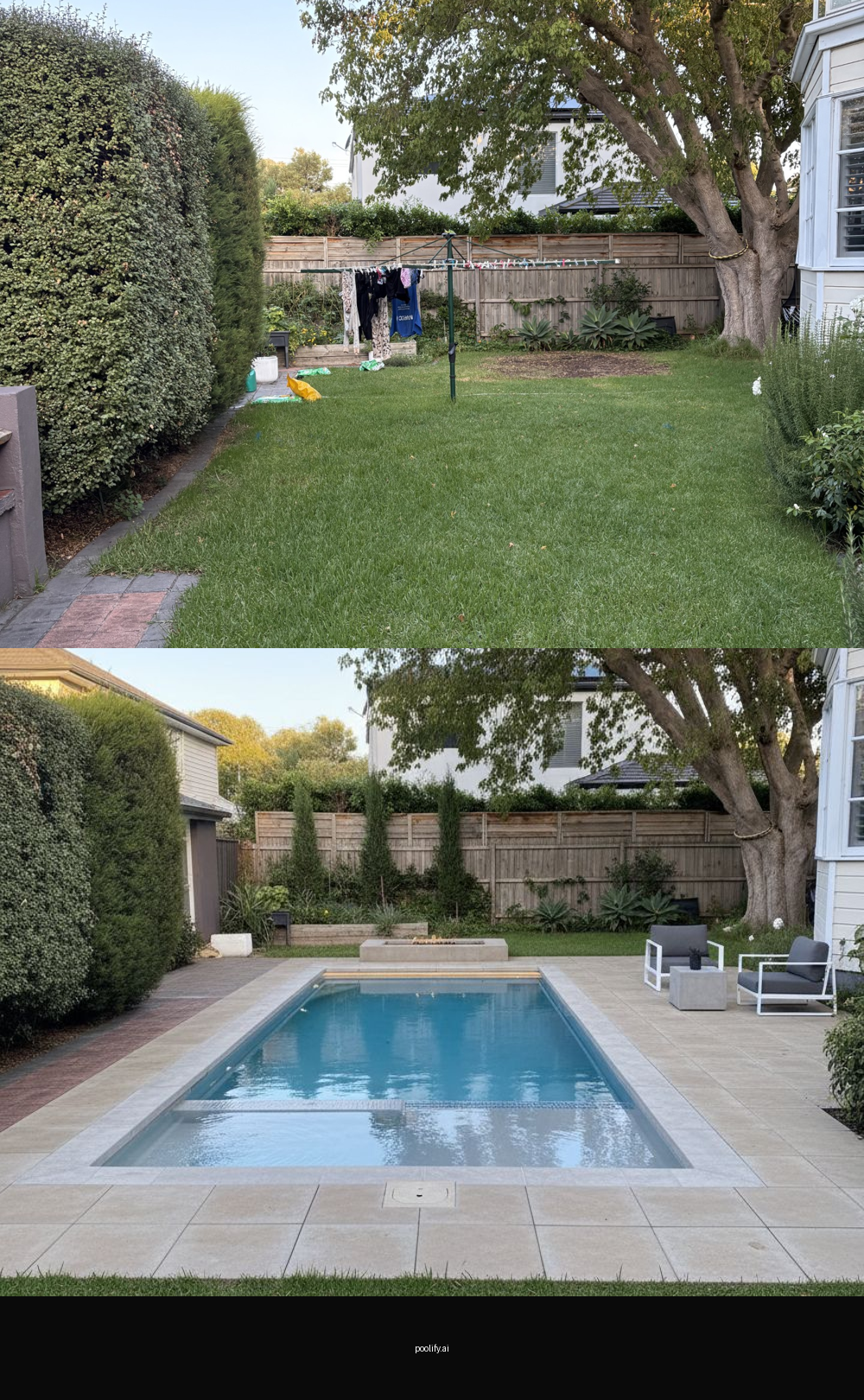
Pool shape is usually chosen on appearance and then lived with functionally. Each common shape suits a particular kind of yard and a particular kind of use, and matching the two is more useful than picking a favourite in isolation.
This guide walks through the main shape families, what each one is good at, and what it gives up.
Rectangular Pools
The rectangle is the most space-efficient shape for a regular yard. It aligns easily with buildings and boundaries, it is straightforward to cover, and it makes the surrounding decking simple to plan.
Suits yards that are
- Regular in shape
- Aligned to the house
- Intended for lap or lane swimming
- Designed in a modern or formal style
- Tight enough that efficiency matters
The trade-off is that a rectangle emphasises alignment, so it looks wrong if it sits slightly off-axis to everything around it.
L-Shaped Pools
An L shape separates two uses without needing two pools. One leg can carry depth for swimming while the other holds a shallow or lounging zone, which suits households with mixed needs.
Works well when
- Two distinct uses are required
- The yard has a corner to exploit
- Supervision of a shallow zone matters
- A single rectangle would be too long
- Circulation can wrap the inner corner
The inner corner needs deliberate planning, because it is where decking, circulation and sightlines all meet.
Freeform and Curved Pools
Curved shapes suit informal, planted landscapes and irregular lots. They can follow the contours of a yard in a way straight geometry cannot, and they read as softer against natural planting.
Fits yards that are
- Irregular in outline
- Heavily planted or wooded
- Informal in overall style
- Sloped or contoured
- Large enough to absorb the shape
The cost is efficiency: curves use space less economically and can complicate covering, so they suit yards with room to spare.
Lap and Long Narrow Pools
A long, narrow pool prioritises swimming distance over surface area. It fits along a boundary or a side yard, and it turns space that would otherwise be circulation into usable water.
Consider when
- Exercise is the primary purpose
- The yard is long and narrow
- A side yard is otherwise unused
- A full-width pool would dominate
- Lawn or planting must be preserved
It is a specialised shape, and worth choosing only if lap swimming is genuinely a priority rather than an aspiration.
Plunge Pools and Compact Shapes
A plunge pool accepts that swimming is not the point. It is designed for cooling off, relaxing and looking good, and it does those things in a footprint that would not accommodate anything else.
Appropriate where
- Space is genuinely limited
- Cooling off is the main use
- A visual focal point is wanted
- Maintenance should stay modest
- The yard must retain open ground
Treated as the intended solution rather than a downsized compromise, a plunge pool can be the most satisfying option on a small lot.
How to Choose Between Them
The shape decision becomes straightforward once the yard and the use are both defined. It is difficult only when it is made first.
Decide in this order
- What the pool is primarily for
- What the yard’s usable shape actually is
- How much open ground you want to keep
- What style the house and yard suggest
- Which shape satisfies the first four
Working through these in order usually leaves one or two viable shapes, which is a much easier choice than an open field.
See Your Dream Pool in Your Actual Backyard
Upload a photo and get an AI-designed pool visualization in 10 seconds. 3 free designs, no login required.
Try Poolify Free →Define the use, measure the usable shape, decide how much yard to keep, and the shape family follows. Visualizing two or three candidates in your own yard settles the rest.
