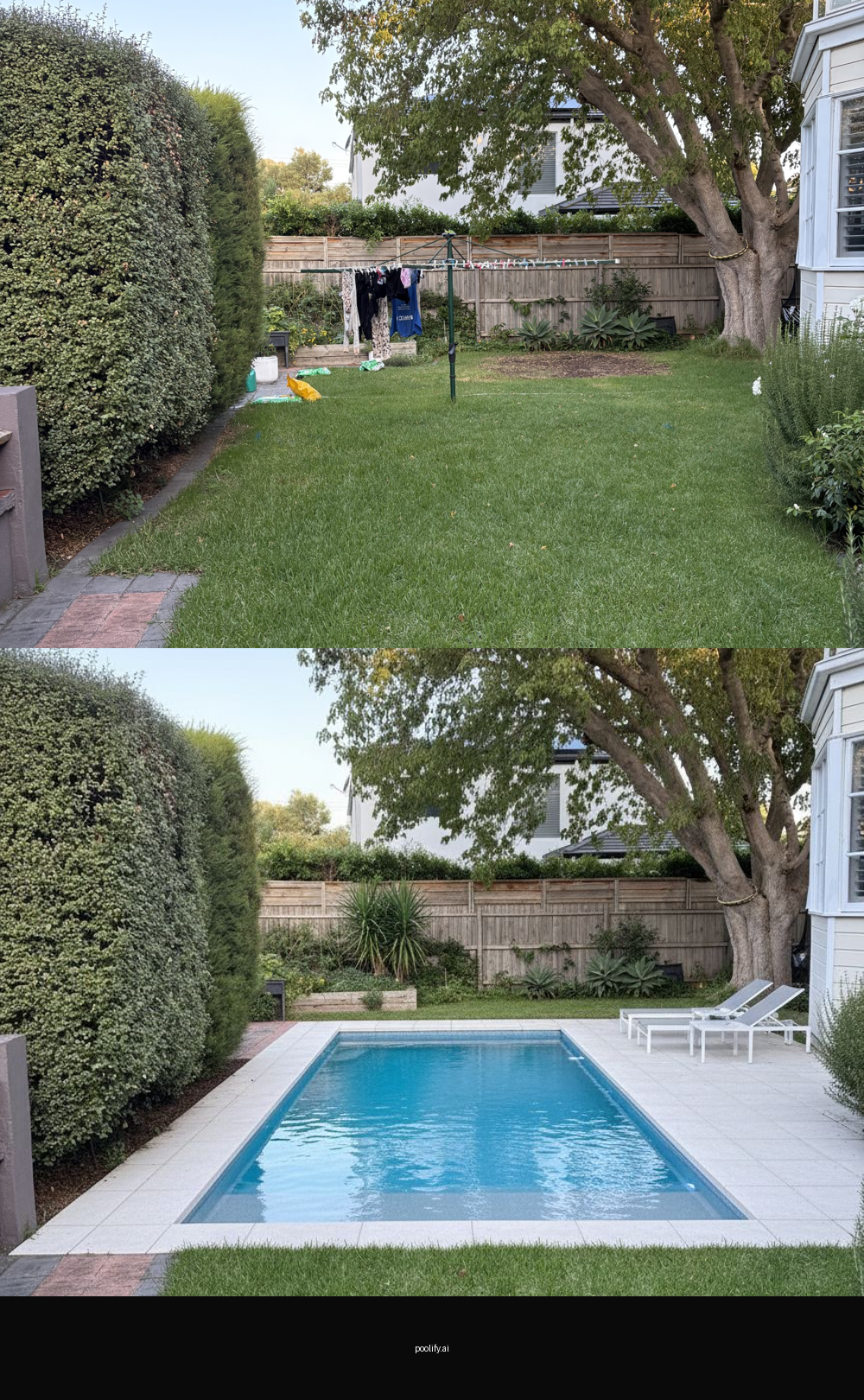
A before and after pair is one of the fastest ways to understand what a pool would do to a backyard. It is also easy to read badly, because the eye is drawn to the water and away from everything else that changed.
This guide covers how to read a before and after properly, and which parts of it are worth trusting.
What a Before and After Actually Shows
The pair shows a plausible transformation of a specific yard. Its value is comparative: it shows what changed, in a space you already know, which is far more informative than a photograph of someone else’s finished pool.
Read it for
- Position of the pool within the yard
- Proportion of water to remaining ground
- How the pool relates to the house
- What was removed or displaced
- Where circulation would naturally run
None of these require the image to be technically precise. They require it to be spatially honest, which is a lower and much more useful bar.
Look at the Fixed Constraints First
Before judging the design, identify what could not have moved. Structures, boundaries, mature trees and level changes constrain any real design, and a concept that quietly ignores them is less useful than one that works around them.
Check they are respected
- Property boundaries and existing fencing
- The house footprint and door positions
- Mature trees and planting
- Visible level changes
- Existing paths and access routes
If a concept has removed something that cannot be removed, adjust your reading of everything else accordingly.
Judge the Deck, Not Just the Water
Most of the time spent around a pool is spent out of it. The area around the water determines whether the yard is comfortable, and it is the part of a before and after that people skip over.
Assess the surrounding space
- Whether paths are wide enough to pass
- Whether seating areas are genuinely sized
- Where shade would fall
- How the deck meets the house
- What open ground remains
A concept with a beautiful pool and unusable surroundings is worth less than a modest pool with a well-planned deck.
Check Whether the Scale Is Honest
Scale is the easiest thing to get subtly wrong and the most important thing to get right. Comparing the pool against objects of known size in the original photograph is a quick sanity check.
Reference against
- Door and window heights
- Existing furniture
- Fence panel widths
- Paving or decking module sizes
- Mature planting
If the pool looks larger relative to those references than you expected, the concept is showing you an aspiration rather than a fit.
Use the Pair to Ask Better Questions
The most productive outcome of a before and after is a shorter list of questions for a professional. It converts vague preferences into specific ones.
Questions it tends to surface
- Can the pool sit this close to the house
- What happens to drainage in this position
- Does this layout meet local requirements
- What would need to be removed
- How would access for construction work
Arriving at a site visit with these questions already formed makes the visit considerably more useful.
Generate Several, Not One
A single concept invites a yes or no answer. Several concepts of the same yard invite comparison, which is a much better way to discover what you actually prefer.
Vary one thing at a time
- Position within the yard
- Shape and orientation
- Size relative to remaining ground
- Style and material direction
- Where seating and shade sit
Changing one variable at a time makes it obvious which variable your preference is actually responding to.
See Your Dream Pool in Your Actual Backyard
Upload a photo and get an AI-designed pool visualization in 10 seconds. 3 free designs, no login required.
Try Poolify Free →Check the fixed constraints, judge the deck as carefully as the water, sanity-check scale against known objects, and compare several concepts rather than reacting to one.
